

Kings of Hwicce
The key to understanding exactly when and how this British dynasty split off into a Saxon Wessex comes from a close inspection of the early sources surrounding the Kingdom of Hwicce. As we shall see this will yield some interesting conclusions about the origins of the royal dynasty of Mercia.
The Diocese of Worcester is referred to as “diocesis Hwicciorum” in an 8th century episcopal grant and so the two territories are generally considered coterminous thus Hwicce was comprised of Gloucestershire, Worcestershire and some parts of neighbouring counties. Importantly it included the Roman cities of Gloucester and Cirencester which was the capital of the province of Brittania Prima (roughly Wales) and Civitas Dobunnorum. We know from an inscription on a milestone from Magnis (Kenchester) that the Civitas Dobunnorum also included the neighbouring territory called variously “Magonsaete”/ “Heechan”/ “Western Hecani”/ “Westerna” which was coterminous with the Diocese of Herefordshire. As mentioned earlier Heechan was most likely originally a Sub-Kingdom of Hwicce. Both of these Sub-Kingdoms are nearly always mentioned in documents such as land grants and charters as subordinate to the Kingdom of Mercia.
Following the work of Coates “Hwicce” is “a Brittonic name consisting of the ancestor of Modern Welsh gwych ‘excellent’ with the positive prefix hy-, i.e. something like ‘the most excellent’”. Similarly following Koch “Heechan” is from the same Brythonic prefix “hy-” coupled with “echen” meaning “lineage” thus “the best lineage”. The similarity in naming conventions between Hywych (“most excellent”) and Hyechen (“best lineage”) reinforces the idea these are in some sense sister Sub-Kingdoms of the former Dobunni or Sub-Kingdoms within Ceredic’s greater imperium of Glewising.
Bede writing about Saint Augustine in the year 603 says he “summoned the bishops and teachers of the neighbouring British kingdom to a conference… ...on the borders of the Hwicce and the West Saxons.” This clearly implies that Hwicce was still considered a British Kingdom that bordered Wessex at this time. Furthermore in order to represent the interests of the entire insular British church it must have been considered one of the most powerful British Kingdoms. This makes sense given it contained Gloucester-Cirencester, the power centre of Britannia Prima. Henry of Huntingdon confirms this in his account of the same event referring to Hwicce as “the largest and nearest province of the Britons”. Bede identifying Hwicce as a British territory in 603 is in direct contradiction to the ASC entry for the year 577 mentioned earlier in which Ceawlin (Caw) captured Hwicce killing and displacing Cynheiddon ruler of Cirencester and Cynfael ruler of Gloucester. A careful look at the events between the years 577, 603 and beyond will reconcile this contradiction whilst also pinpointing how a factional split within the British Gewis-Glewis aristocracy lead to the rise of the royal dynasties of both Wessex and Mercia.
The HB tells us that Penda was “the first to separate the kingdom of the Mercians from the kingdom of the Northumbrians”. In other words Penda was the first of his lineage to rule Mercia by taking it from the rule of Northumbrian kings. This pre-Penda Northumbrian overlordship of Mercia is confirmed by the “Tribal Hidage” tribute list. Following the conclusions of Higham this list was compiled for Edwin King of Northumbria in 626. It is further confirmed by Bede who tells us Penda became overlord of Mercia in 633 as a direct result of supporting Cadwallon “King of the Britons” in a battle killing Edwin. The ASC tells us that Penda was king of an unspecified domain from 626. If Penda only gained overlordship of Mercia in 633 he must have ruled some other kingdom from 626. The ASC entry for 628 tells us the Kings of Wessex “fought with Penda at Cirencester, and afterwards entered into a treaty there”. It has been deduced from later sources that this was a victory for Penda (Hwicce is only mentioned as a Sub-Kingdom attached to Mercia from this date). We will discuss Penda’s rise to power alongside Cadwallon in more detail later. In summary Penda was an active ruler in Hwicce from 626-628 before gaining overlordship of Mercia in 633.
This suspicion that Penda was originally a ruler in Hwicce before conquering Mercia is reinforced by an excellent place name study by Graham Jones. Jones compiled a large corpus of “Place-names containing personal names associated with those of early Mercian kings” namely Peada, Penda, Eowa, Pybba and Creoda. As illustrated in the figure below the glaring conclusion of this study is that the “distribution of names… ...concentrated… ...particularly in and around the territory of the Hwicce.”
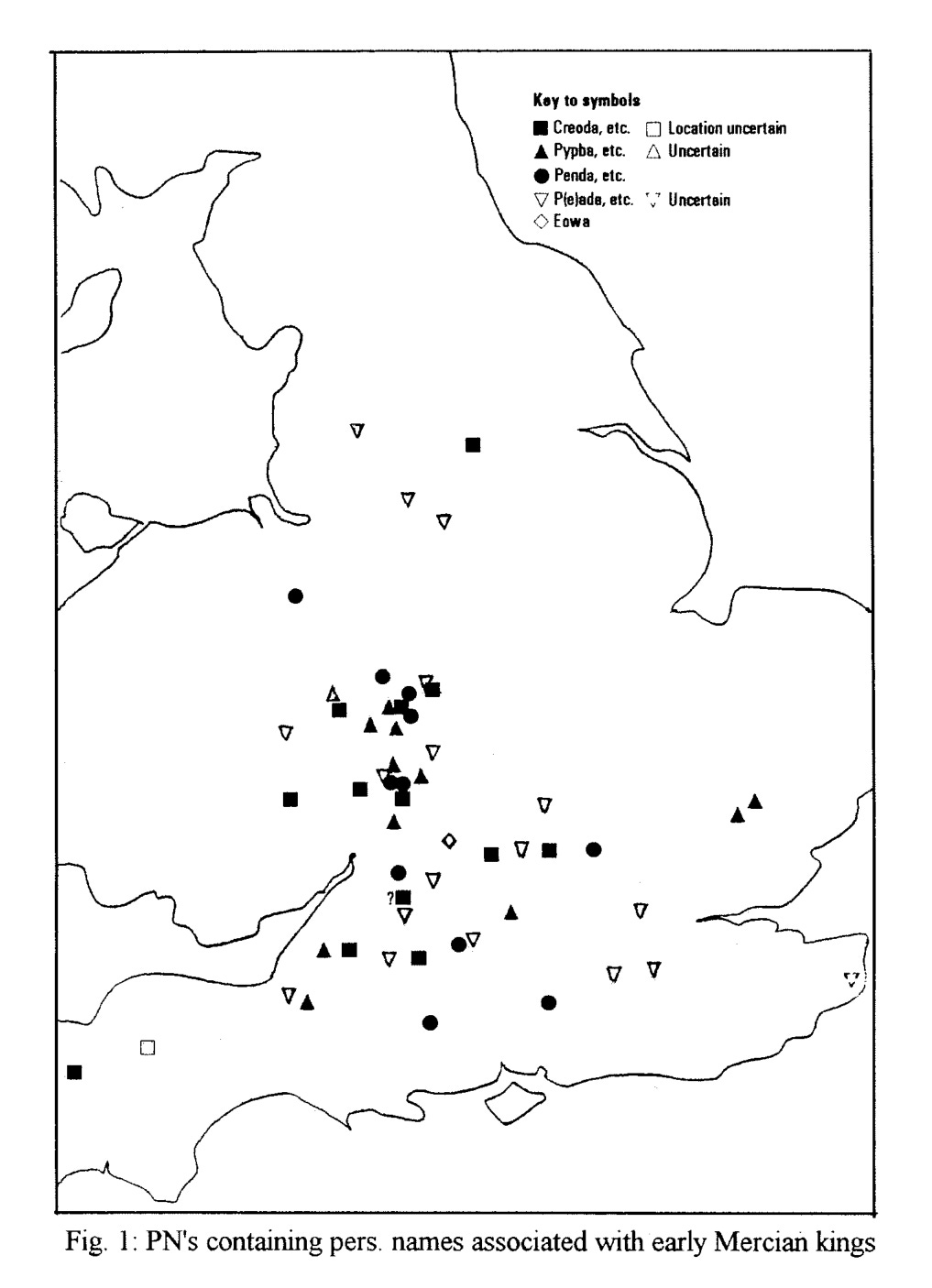
This evidence confirms the suggestion (from HB, Bede and ASC) that Penda and his predecessors were based primarily in Hwicce until Penda took control of Mercia by conquest alongside Cadwallon “king of the Britons” in 633. Penda’s ancestors such as Pybba and Creoda were evidently present in Hwicce during the strange period when it was conquered by Ceawlin in 577 but reverting to an unambiguously non-Wessex British identity by 603. Penda is often portrayed as a bulwark of Anglian Pagan identity whilst simultaneously holding an unparalleled special relationship with the Christian Britons. These two contradictory characteristics seem counter intuitive. Both claims will be analysed in detail later.
Cerdic and other members of the Gewisse possessing Brythonic names is well known, but as Jones summarises, most scholars believe Penda and his family also had Brythonic names. The multiple -a ending forms (Creoda, Pybba, Penda, Peada, Eowa etc) indicate hypocorism and as Padel suggests “might have begun as Brittonic epithets, not personal names, which were borrowed, shortened hypocoristically by the English and turned into personal names, their derivation from Brittonic ‘soon lost to sight for both Brittonic and English speakers’”. Analysing each name in turn reveals the most likely Brythonic root whether epithets or personal names. As outlined earlier Creoda/ Cryda/ Crida is either a Brythonic name in its own right derived from “cred” meaning “faith” or more likely a corrupt form of Welsh Saint Cwrda itself a hypocoristic form of “Cawrdaf”. Pybba is more difficult but a derivation from the Brythonic “pybyr” meaning “strong, mighty or brave” is most widely supported. It is used as both an epithet for example the Mabinogi figure “Gronw Pybyr” but also as a personal name as in an obscure pedigree “Pybyr ap Caper” (ABT 22). One Welsh spelling of the name “Pyd” could arguably preserve a more accurate form which makes the common Brythonic name “Pedr” a possibility. It may even be Pedr was his personal name and Pybyr his epithet, but for now “Pybyr” as a personal name is tentatively accepted. One Welsh spelling of Penda is “Panna” which is attested elsewhere in the anonymous Life of Cuthbert as “Penna” belonging to a British priest (discussed in a forthcoming article). This tells us that it is most likely a Brythonic personal name not an epithet. Most spellings agree that the first element is the Brythonic “pen” meaning “head” or “chief” and the second element begins with a “d”. Padel suggests a hypocorism of “penndav” meaning “chiefmost”. Sims-Williams suggests the second element is proto-Celtic “dagos” meaning “good” attested in continental names such as “Ollodagus”. The Welsh form of “dagos” is simply “da” which would make “Pen” + “da” neatly mean “Good Chief”. Neither of these is very convincing as a full personal name. I would suggest the Mabinogi attested personal name “Pendaran”. The second element “daran” or “taran” is attested in its own right as a personal name “Glinneu ail Taran” (“Glinneu a second Taran”) or in the name of the deity “Taranis”. Common Welsh phrases “mellt a tharanau” (lightening and thunder) or “taranfollt“ (thunderbolt) reveal “taran” means “thunder”. The other element used in these phrases “fellt” or “mellt” meaning lightening bolt is also attested in the Brythonic name “Rhiainfellt” meaning “Princess of Lightening”. I believe “Penda” is a hypocorism of “Pendaran” with a similar meaning “Chief of Thunder” which is an appropriate name for the warlord. The Brythonic spelling “Pantha” in HB and Annales Cambriae is compatible with Welsh element “tharan” where “dagos” isn’t. “Peada” or sometimes spelled “Pada” (Peada is likely an a-mutation of Pada) is also difficult to interpret but may be a hypocorism of commonly used Brythonic “Padarn” a borrowing from Latin “Paternus” meaning “Father”. “Eowa” is another unique name where the Old English “eowa” for “ewe” meaning “female sheep” is a somewhat unlikely name for a king. Jones links the place name “Evenlode” to Eowa where historical forms in early charters of Offa and Edgar include “Eowenland” and “Eowengelade”. Clearly the first element “Eowen” corresponds to the common Brythonic name “Owen”, “Ewen” or “Owain”. In addition to these well known figures we have the lesser known Merewalh, Penwalh and Cenwalh. The second element in each name “walh” or “wealh” is the same root as the word “Welsh” essentially meaning “Briton”. There has been much discussion about the interpretation of this element in Old English names but Koch offers the best solution. As we will discuss later Koch identifies “Merewalh” with a figure from Welsh poetry called “Morfael”. Koch suggests the name begins Early Medieval Brythonic “Mormail” (modern “Morfael”) where the second element has the International Phonetic Alphabet spelling “μail” producing an initial “v” or “w” sound “and that OE Merewalh results from an Anglicizing reinterpretation”. Looking at the historical spelling variations of the similar name “Arthfael” (Arthmail/ Arthuael/ Arthvael/ Arthwael) shows how the second element “wael” could easily be interpreted as equivalent to OE “wealh”. This gives us the Brythonic names Morfael (Great Prince), Penfael (Chief Prince) and Cynfael (Hound Prince).
Jones notes that the pre-Cryda names in the Mercian pedigree such as Cnebba and Icel have a radically different place name distribution concentrated in the south east of England writing “the geographical contrast… ...is mirrored by a philological distinction between the Germanic origins of the personal names Icel, Cnebba, Cynewald and Guthlac, and the possible Celtic influences (Penda, Cryda etc)”. This clear geographical and philological difference strongly suggests the pre-Cryda names are late interpolations added to the Mercian pedigrees to provide a suitable Germanic origin story obscuring a politically inconvenient one.
Before we have a closer look at the uncertain ancestry prior to Cryda a brief summary of the British characteristics of Penda and his family is in order. They possessed Brythonic names; ruled the early British kingdom of Hwicce before conquering Mercia. Penda is the latest entry in a document called “Englynion y Beddau” (EyB) (“Stanzas of the Graves”) that lists the final resting places of British heroes. In one version he is named as Penda but in another he is strangely called Rhun: “The grave of Rhun/ Penda ap Pyd in the horror of a river”. “Rhun” is either a mistake; a preservation of his real personal name if Penda is an epithet or two separate entries with “Rhun” being an otherwise unattested brother of Penda. Whatever the answer Penda must have been considered a Briton in some sense to be listed at all. There is no recorded hostility between Penda and the Britons where there is recorded hostility between Penda and most English kingdoms. As we shall see Penda was effectively installed as a ruler by Cadwallon “King of the Britons” and his subsequent closest allies were a series of British kings e.g. Cadafael, Cynddylan etc. He is portrayed in “Marwnad Cynddylan” and the HB as a kind of High King of the Britons: “Oswy delivered all the riches that he had in the city into the hand of Penda, and Penda distributed them to the kings of the British, that is the ‘Distribution of ludeu’”. This role arguably makes Penda a direct successor to Cadwallon. The heartland of Penda’s territory in the West Midlands has hardly any Pagan Anglo-Saxon burials but plentiful evidence of British Christianity (we will discuss the strong association Penda has with Paganism later). Even as late as the 8th century and as far east as Lincolnshire the Mercian aristocracy were bilingual. The “Life of Saint Guthlac” tells us Guthlac was son of Penwalh (“Chief Briton” or Brythonic “Chief Prince”) of unspecified Mercian royal stock, maybe a descendant of Penda’s brother Cynwalh if a repeating name element was passed down. Guthlac “realized that British hosts were approaching his dwelling: for in years gone by he had been an exile among them, so that he was able to understand their sibilant speech”. Even the Old English name “Mercia” meaning “border people” implies an emergence from the Anglo-British interface between two interacting peoples. Koch commenting on some of this evidence writes it implies “either that Mercia was ruled by a Germanic family heavily influenced by Brythonic culture and/or intermarrying with Brythonic kin-groups, or that the Mercian kingdom was essentially a Brythonic entity which adopted Germanic speech and Anglian identity.”
As previously deduced the pre-Cryda names in the early Mercian pedigree are probably late interpolations. It is therefore of critical importance to determining the origin of Mercia to identify the real ancestors of Cryda. The only clues we have to go on are a floruit of roughly 575 (Penda’s floruit beginning 626 minus two generations of 25 years each) and a base of operation somewhere in and around Hwicce. There is only one obviously compatible candidate. The ASC records the death of a Cryda alongside Ceawlin in 593 in the wake of the battle of “Woddesbeorg” fought between the Britons of Hwicce and kings of Wessex. This “Cryda” isn’t clearly identified but the entry does tell use he was a generational contemporary of Ceawlin, with a roughly 575 floruit, and operating around Hwicce which matches our requirements. This is the same Cryda discussed earlier that is associated with the Gewisse.
The ASC records the death of Cutha at the battle of Fethanleag in 584. Henry of Huntingdon (HoH) records this same event but adds “Crida, as far as we learn from old records, was the first king of Mercia… ...I have pointed out the dates and revolutions as clearly as I could from what we find in the books of ancient writers, bringing them into relation with the eras of the kings of Wessex.” Under the year 593 after the battle of Woddesbeorg HoH writes “Crida, king of Mercia, departed this life, and his son Pybba succeeded him.” Only HoH and a few other post-Conquest chroniclers explicitly equate the ASC Gewisse Cryda d.593 with Crida of Mercia. HoH may have had access to a Mercian regnal list with succession dates that lead to him equating Crida of Wessex and Crida of Mercia as the same individual. Even if the authority of HoH is doubted the “Mercian” Crida operating in Hwicce with a floruit of 575 is enough to suggest equating him with the ASC Gewisse Crida d.593 by itself. It is highly doubtful there were two separate Cryda’s operating in the Hwicce area at the same time therefore we can conclude they are the same individual.
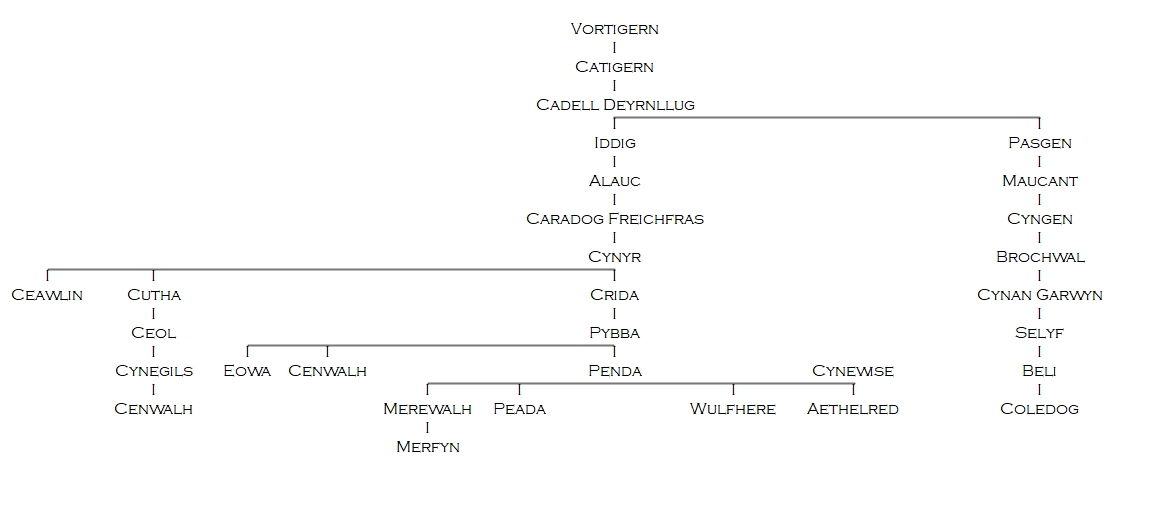
There is much confusion surrounding the pedigree of Cryda. In some sources such as WSGRL and some versions of the ACP Cryda is made a son of Cerdic and father of Cynric but the most authoritative versions of ASC omit Cryda completely and make Cynric son of Cerdic. Another version of the ACP (Dumville labels as version “T”) makes Cryda son of Cynric (“Ceawlin Cynricing, Cynric Creoding, Creoda Cynricing, Cerdic Elesing”). This “Creoda Cynricing” is probably an error for “Creoda Cerdicing”. However taking “Creoda Cynricing” in isolation gives the only credible pedigree that places Cryda in the correct generation to be a grandfather to Penda and dying alongside Ceawlin in 593.
The Mercian pedigrees universally agree a “Cynewald” was father of Cryda. While this appears to be a straightforward Germanic name that we previously suspected to be an interpolation there is another possibility. HoH spells the name of the king of Wessex “Cenwalh” incorrectly with a “d” as “Kenwald”. Some versions of the Life of Saint Guthlac make the same mistake by spelling “Penwalh” as “Penwald”. Cryda has a documented grandson called “Cenwalh”, a brother of Penda. Given that names often recur in family dynasties it isn’t an unreasonable assumption that Cryda’s father is another instance of this common mistaken spelling of “Cynwalh” as “Cynwald”. As we have seen “Cenwalh” derives from the Brythonic “Cynfael”. The Cynfael ruler of Gloucester in Hwicce deposed by Ceawlin in 577 would then be another suitable candidate for the father of Cryda. As discussed Cynheiddon ruler of Cirencester was a son of Cynyr ap Caradog making the 577 conflict with Ceawlin son of Cynric son of Cerdic seem more like an internecine conflict. All these alliterative “C” names make it likely Cynfael ruler of Gloucester also belonged to the Glewis dynasty. It is tempting to speculate that this Cynfael was another son of Cerdic which would give us another intriguing component of the 577 civil war and place Cryda in the right time and place.
While fabricating or reconstructing a pedigree for Cryda (as son of Cynfael son of Cerdic) is tempting, it is far too speculative to make a strong case. As stated HoH writes that Cryda was made king in 584 after the death of Cutha in the same year. This implies he was heir to Cutha in some capacity, either his son or perhaps younger brother. The ASC tells us Cryda died alongside Ceawlin in 593 implying they roughly shared a floruit and had a close relationship. As Ceawlin (d.593) and Cutha (d.584) were themselves brothers, the combined implication is that Cryda had a fraternal relationship with both and was probably their younger brother. For this reason I favour the aforementioned ACP (T) entry “Creoda Cynricing”. It is clear later genealogists knew Cryda fitted in to the Gewisse family somewhere but were unable to accurately place him. Overall the evidence suggests Cryda was a son of Cynric and a younger brother to Ceawlin and Cutha. This Cryda was the progenitor of what became the Mercian royal dynasty as father to Pybba and grandfather to Penda. This conclusion that the Mercian royal dynasty originated as an offshoot of the Gewisse-Glewis in Hwicce may even further vindicate the oft doubted GoM who described the wife of Cadwallon and sister of Penda as “belonging to the noble line of the Gewisse”.
From Gewis-Glewis to Pagenses-Mercia
With these conclusions in mind we can now analyse the sequence of events comprising the internecine conflict within the Gewisse-Glewis dynasty. To recap, the ASC entry for 577 has brothers Ceawlin and Cutha depose Cynheiddon ruler of Cirencester and Cynfael ruler of Gloucester. This is normally taken as a West Saxon annexation of Hwicce but as Bede writes Hwicce was once again an independent British kingdom by 603. Evidently something strange happened during the intervening years (577-603). Cynheiddon is listed as a son of Cynyr ap Caradog in Welsh tradition and is thus suspected to actually be a brother of Ceawlin (son of Cynric son of Cerdic). Cynfael is probably also a member of the Gewisse-Glewis dynasty. This casts the events of 577 in a very different light. This wasn’t interethnic strife but internecine squabbling. This kind of fighting between close family members was not uncommon for example the split within the House of Wessex in which Aethelwald revolted against his cousin Edward the Elder; or in Northumbria Alhfrith rebelling against his own father Oswy. It is very likely Ceawlin and Cutha had a large number of upper Thames Valley Saxons composing their host. These were probably long standing federates, maybe even dating as far back as Vortigern’s time. Ceawlin and Cutha were probably Sub-Kings that became the predominant Gewisse-Glewis co-regents as a result of the 577 victory in Deorham.
In the year 584 the ASC says “Ceawlin and Cutha fought against the Britons at the place which is named Fethanleag, and Cutha was there slain; and Ceawlin took many towns, and countless booty; and wrathful he thence returned to his own.” It has been suggested “Fethanleag” can be identified with “Fethelee” in Stoke Lyne, Oxfordshire but this cannot be accepted as it lays well within Ceawlin’s existing core territory and wouldn’t represent any kind of expansion. A better identification is “Faddiley” near Chester, Cheshire.
As discussed above Cynan Garwyn shared descent from Cadell Deyrnllug with Ceawlin. They both fall in the same generation and shared roughly the same floruit 575-ish. Following Koch’s interpretation of the aforementioned 6th century poem TCG Cynan was ruler of “Heechan” (Herefordshire). TGC portrays Cynan as a warlike ruler who raids many surrounding kingdoms but curiously never mentions any conflict with any Anglo-Saxon groups or Wessex controlled Hwicce on his south eastern border. This implies a non-hostile relationship with Ceawlin. TCG also makes clear that Cynan is in the process of invading the expansive “Cornouii”. As we will discuss later, it is clear Cynan must have successfully annexed “Cornouii” as his son Selyf is depicted as the dominant “King of the Britons” ruling a rebranded kingdom called “Powys” including the formerly Cornouii region. It seems likely that Cynan’s conquest of “Cornouii” was a campaign pushing northwards up the Severn valley fought in alliance with Ceawlin who “took many towns” after the battle of Faddiley near Chester. Cynan was probably a tributary Sub-King to Ceawlin and Hwicce at this time. HoH informs us that in the same year after the death of Cutha at Faddiley Cryda (Cutha’s younger brother) succeeded to rule. Based on the evidence previously outlined (Jones’ place name study etc) the territory Cryda ruled was Hwicce. While Ceawlin ruled over a large “imperium” as a “Bretwalda” including large swathes of Saxon territory, Cryda was a Sub-King of the predominantly British territory of Hwicce.
Most versions of the ASC record: in 591 “Ceol reigned for five years”; in 592 “there was a great slaughter at Wodnesbeorg, and Ceawlin was driven out” and in 593 “Ceawlin and… ...Crida perished”. These three entries are clearly related and there may be some minor confusion to the order of events, it should probably be rectified Ceol (son of Cutha) replaced Ceawlin after his death at the battle of Wodnesbeorg. ASC MS E adds that the slaughter at Wodnesbeorg happened “on Brytene”. A literal translation means “in Britain” but some have inferred that the great slaughter occurred *in the land of the Britons* (“on Brytene”) thus involving the Britons. William of Malmesbury (WoM) writing on these events says Ceawlin “was driven from his throne, and became a piteous spectacle to his enemies. Both nations had heard the trumpet call to vent their hate against him; English and Britons conspired together and cut his army to pieces at Wodnesdic; and in the thirty-first year he was deprived of his kingdom, went into exile, and forthwith died.” HoH also writing on these events says “Ceawlin died in the thirtieth year of his reign, and after him Ceol reigned five years… ...the Britons and Saxons fought a battle at Wodnesburie. The British army advanced in close order, after the Roman fashion, but the Saxons rushed forward with desperate, but disorderly, courage, and the conflict was very severe. God gave the victory to the Britons; and the Saxons, who commonly were as much superior to the Britons in fight, as they were slower in flight, suffered much in their retreat. After these times Crida, king of Mercia, departed this life, and his son Pybba succeeded him.”
When considering the information supplied to us by Bede that Hwicce was an independent British kingdom by 603 it is likely that the “Britons” were involved in this rebellion alongside Ceol against Ceawlin. This faction of “Britons” was probably just Ceawlin’s younger brother Cryda collaborating to install his nephew Ceol. It is probable Cynan Garwyn was also fighting alongside Cryda. Cryda and Ceawlin died on opposite sides of the battle of Wodnesbeorg (Adam’s Grave, Wiltshire). It is in this period during the 590s that a Saxon identity began to dominate in what became Wessex under Ceol whilst a British identity was retained in Hwicce under Pybba.
Bede writing about the period between 604-616 says “Osfrith and Eadfrith, sons of King Edwin, their mother being Cwenburh, daughter of Cearl, king of the Mercians; they were born while he was in exile”. This “Cearl” does not appear in any of the later Mercian pedigrees linked to the dynasty of Penda. There is no indication of Brythonic origins in the name Cearl or his named descendants. As Penda was the first of his line to rule Mercia from 633 it is likely Bede can be taken at face value and we can conclude “Cearl” was from an earlier Anglian dynasty in Mercia proper completely unrelated to Penda. HoH does claim Cearl was some kind of unspecified “kinsman” succeeding Pybba who allegedly died in 597 but both of these claims are spurious interpolations based on Bede. Pybba probably continued to rule Hwicce until 614 whilst Cearl was ruling Mercia.
Bede tells us further that Edwin “was being persecuted by his predecessor Aethelfrith, he wandered secretly as a fugitive for many years through many places and kingdoms, until at last he came to Raedwald and asked him for protection against the plots of his powerful persecutor.” Bede continues that Aethelfrith “sent messengers offering Raedwald large sums of money to put Edwin to death… ...and further threatening to make war on him if Raedwald despised his offer.” Edwin’s nephew Hereric was killed in similar circumstances whilst driven into exile by Aethelfrith. He was poisoned by the British King Ceretic of Elmet whilst under his protection. It is highly likely this was done at the behest of a similar carrot and stick offer made by Aethelfrith. After Raedwald rejected Aethelfrith’s proposal to kill Edwin they fought the Battle of the River Idle in 616 after which Edwin was installed as king of Northumbria.
It is clear from this series of events that Aethelfrith was determined to snuff out his dynastic rival Edwin with military action. It is also clear that at some point shortly before 616 Edwin was, for some unknown reason, forced to flee the protection of Mercian King Cearl and seek the protection of King Raedwald. Higham writes “The battle of Chester is the only battle known to have been fought by Aethelfrith against his southern neighbours. Unless Bede omitted mention of another at least as important, Cearl was a victim of the Chester campaign.” Following Higham, as the only possible event that could have precipitated Edwin’s withdrawal from Mercia, the Battle of Chester was probably another attempt by Aethelfrith to destroy Edwin and his protectors. The Annales of Ulster tell us that Selyf was the leader and “King of the Britons” that was defeated by Aethelfrith at Chester. Koch ingeniously suggested that Selyf was the primary target of Aethelfrith because he was the overlord and protector of Cearl and Mercia at the time. Whilst it may be counter-intuitive that the King of Powys ruled over the Mercians, at this time Mercia was a relatively minor kingdom whereas Chadwick surveying the available evidence concluded “taking Selyf ap Cynan as British commander at Chester” with his territory “Powys as covering the whole region between the Severn and Dee estuaries”. This fits with the previously discussed and evidently successful conquest of Cornouii by Selyf’s father Cynan.
One aspect of the battle which left a lasting impact in the British memory (strangely reminiscent of the slaughter of the Druids of Anglesey by the Romans centuries earlier) was Aethelfrith’s slaughter of the monks of Bangor. Bede rationalised the Pagan kings actions as “the prophecy of the holy Bishop Augustine was fulfilled… ...namely that those heretics [insular Christian Britons] would also suffer the vengeance of temporal death”.
The Annales of Tigernach (AoT) record that a king called “Cetula” died alongside Selyf at Chester. Breeze amends this to “Cetual” and identifies him as Cadwal of Rhos however there is an alternative. The name “Cadwal” or “Cetual” is from the Proto-Celtic Katu + Walos (Battle Prince) and is cognate with the Irish “Cathal”. In later centuries the name “Charles” was used as an Anglicised spelling of “Cathal”. “Charles” is a name that developed from the same Germanic root as “Cearl”. It is therefore possible that the name “Cetual” in the AoT is an attempted Gaelicisation of an unfamiliar English name “Cearl”. Although this possibility is less likely what is certain is that after the Battle of Chester in 613-ish Edwin no longer enjoyed the protection of Cearl and fled to Raedwald.
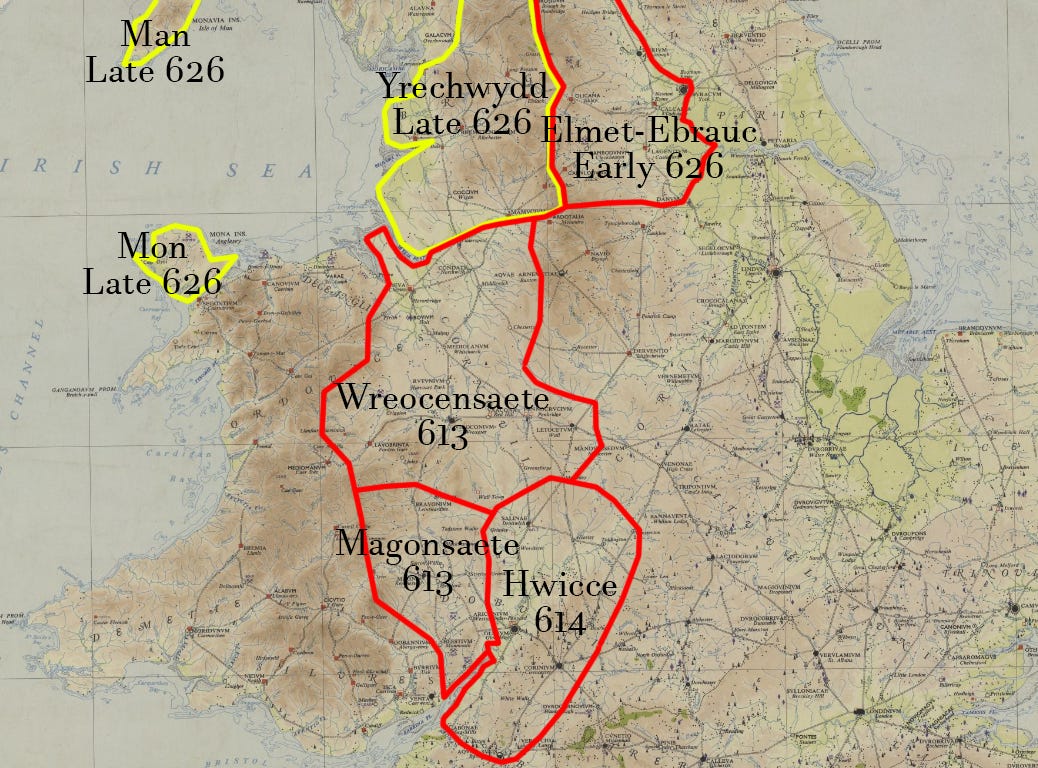
Following the interpretation of Higham, the Tribal Hidage lists all the kingdoms tributary to Edwin in 626. It is divided into two halves: the first half includes Mercia (and its subkingdoms), Wreocensæte (Civitas Cornouii) and Westerne (Heechan). Higham deduced this first group corresponds to the previous overlordship of Aethelfrith which Edwin inherited after being installed in Northumbria from 616. Evidently Aethelfrith had made the British overkingdom that called itself “Powys” (Cadelling ruled Heechan & Cornouii) including Mercia tributary to Northumbria after the Battle of Chester. It should be noted that while the Tribal Hidage does include the British kingdom of Elmet annexed by Edwin in 625/ 626 it doesn’t include Yrechwydd (Lancashire) or the Menavian Islands two further British territories subjugated later in the same year. The annexation of Elmet and Yrechwydd by Edwin was the event which lead to the exile of Cadwallon and subsequent reconquest, these events will be detailed in an upcoming article. The second half of the Tribal Hidage lists the southern kingdoms of England obtained by Edwin after the death of Raedwald. The second half includes Hwicce suggesting that at some point between 603 and 626 it was re-annexed into Wessex. This was almost certainly a result of the victory of Cynegils (Cynglas?) over the Britons at the Battle of Beandun in 614 listed in the ASC. “Beandun” also spelled “Beamdune” in other manuscripts has been plausibly identified as Bampton in Oxfordshire which has historical spellings “Bentone” and “Bemtun”. Bampton is located directly between Dorchester and Cirencester making it the perfect site for a battle between Wessex and Hwicce. This annexation or making tributary of Hwicce happened in 614 which was the year after the Britons of Powys were made tribute by Aethelfrith. It seems Wessex were taking advantage of the weakened state of the Britons. This makes 614 the most likely date for the death of Pybba and probably also resulted in the exile of a young Penda from Hwicce.
In a very short span of time the Britons had suffered huge losses putting them into an almost existential crisis. The northern Britons of the Cynwydion (Alt Clut & Gododdin) and the northern Coeling (Rheged) were as yet still independent of Edwin. In contrast the southern Coeling of Elmet, Ebrauc and Yrechwydd had been entirely annexed by Edwin and their last leader Cadwallon exiled to Ireland. Edwin was even encroaching on Gwynedd making the British Menavian Islands (Man & Mon) tributary. The Britons of Powys were still tributary to Northumbria after defeat at Chester and Hwicce was made tributary or annexed by Wessex at Bampton with their leader Penda also in exile.
As we have discussed previously Penda didn’t become ruler over Mercia until 633. The recorded victory of Penda against Wessex at the Battle of Cirencester in 628 marks a reconquest of his ancestral seat. As Penda clearly wasn’t king of Mercia or Hwicce prior to the Battle of Cirencester he must have been made king of another territory in 626 as recorded in the ASC. To defeat and impose terms upon the formidable enemy of Wessex Penda must have commanded a significant force as Gelling writes “the problem of where Penda obtained an army for his first recorded victory against the West Saxons at Cirencester might be solved by assuming that he had the support of the Welsh people of the West Midlands”.
Koch offers some evidence to support this idea from the 7th century poem “Moliant Cadwallon”. The poem depicts the powerful warlord Cadwallon returning from exile in Ireland with his host and landing “In Portskewett, on the estuary where borders meet”. Portskewett is on the Welsh side of the modern Anglo-Welsh border a stones throw from the Severn Bridge and Gloucestershire (Hwicce) beyond the River Wye. The poem depicts British forces mustering prior to his campaign “the hospitality of Cadwallon on the summit of Caer Caradog, as he raises his army to set York ablaze.” The poem continues “[In Port Skewitt on the border] Let the heathen tribe be gone; they have been driven as far as a briny anointing”. Koch offers one interpretation “Penda had been backed by a mostly Welsh army when he defeated Wessex at Cirencester in 628… ...Prior to this, it is likely that the West Saxons had been in a position to sail across the estuary to extort tribute… ...Afterwards, with the Cambrophile Penda as overlord in Hwicce, transmarine oppressors from Wessex were no longer to be feared”. Given that Penda had a supporting role in Cadwallon’s campaign against Edwin it makes perfect sense that Cadwallon had won this loyalty by first supporting Penda’s reconquest of his own ancestral seat, their interests were very closely aligned.
Caer Caradog has been firmly identifed by Breeze with Caradoc Court in Herefordshire with historical forms such as “Caer Caradock”. This identification is also accepted by Woolf and Koch. If this was the stronghold of Cadwallon and presumably his ally Penda this may reveal where Penda first held power from 626. Caer Caradog was located in Heechan (Magonsaete), the traditional primary seat of the Powys Cadelling dynasty. It may be that after the Battle of Chester the mainline branch of the Cadelling were weakened and usurped by Penda whilst he was in exile amongst them. Penda himself was a direct patrilineal descendent of Cadell Deyrnllug. Penda probably ruled all of greater Powys (both Heechan and Cornouii) at this time making him a powerful king. While Penda was tributary to Edwin at first, his move against Wessex by annexing Hwicce wouldn’t have troubled Edwin given he was also in conflict with Wessex in 626 after an assassination attempt. Edwin may have even supported Penda’s campaign as a further punitive measure against Wessex on top of the steep tribute imposed upon them. When Penda’s forces were joined with Cadwallon they were capable of overthrowing and imposing terms upon Wessex as well as deposing the sitting “Brittanniae imperator” Edwin.
It is worth noting some of the locational symbolism from “Moliant Cadwallon”. Firstly and most obviously is Caer Caradoc. The PP says “Caradog Freichfras… ...king of the North and Earl of Hereford; and from his name was bestowed upon it Caer Caradog, and today it is called Hereford.” Secondly in the Life of Saint Tatheus Caradog Freichfras leaves his court in Caerwent to “ride forth on the morrow and show him a place for building that it might be given to God and to himself for a royal and civic palace… ...until he well-nigh came to the bank of the Severn… ...and here be thy royal habitation”. As Port Skewett is on the Severn and is featured in the triads as one of the “Three Chief Ports of the Island of Britain” it is usually identified as one of Caradog’s further courts. As previously discussed Caradog Freichfras was also strongly associated with Cirencester. It therefore seems significant that Cadwallon and Penda mustered at two locations associated with Caradog (Caer Caradog & Port Skewitt) before winning his primary seat in battle (Cirencester). It may be that Penda was trying to legitimise his rule of Hwicce and Powys by emphasising his descent from Ceredic ap Alauc (i.e. Caradog Freichfras). After mustering their forces at Caer Caradog in Heechan Cadwallon and Penda proceeded northwards up the Severn into greater Powys winning victories such as the Battle of Cefn Digoll before proceeding further northwards into Northumbria.
Adomnan writing earlier than Bede says “King [Cadwallon] was slaughtered; and the victor [Oswald], returning from the battle, was afterwards ordained by God as emperor of all Britain [“Brittanniae imperator”].” Koch logically comments on this “victory in the battle would not in itself have made Oswald ‘emperor of the whole of Britain’ unless that was the power that Cadwallon held before Oswald wrested it from him.” Bede lists all the “regibus gentis Anglorum” (“kings of the English nation”) that held an “imperium” over “all the southern kingdoms, which are divided from the north by the river Humber”. This “imperium” is the same concept as that earlier “Brittanniae imperator” put forward by Adomnan and the same concept as the “Bretwalda” (“Ruler of Britain”) in the later ASC. Bede consecutively lists Edwin, Oswald and Oswy amongst those who held this “imperium” but omits Cadwallon and Penda who both undoubtedly achieved similar status during their respective floruits. In the case of Cadwallon this is undoubtedly because he was not an English king but ostensibly as a member of the “gentis Anglorum” Penda should be expected here. I would even speculate that some of the British Coeling kings north of the Humber (Coel, Urien & Arthur) were also “Brittanniae imperator”.
Moliant Cadwallon contains a line which confirms Cadwallon aspired to and achieved this status “Cadwallon, another Einion: the imperium”. Another interesting line associates Cadwallon with the national symbol of Wales: “the dragon chief, defensive citadel of the Cymry, Cadwallon”. This reference may preserve the oldest roots of the symbol which was later confused with Cadwaladyr. After the Battle of Hatfield Chase in 633 Cadwallon seized direct control of Northumbria from which his brief “imperium” was ruled. As Bede informs us, Penda became overlord of Mercia in the same year of 633 after Edwin, the previous overlord of Mercia, was killed. Presumably this overlordship was granted as reward for supporting Cadwallon, but it may also represent a return to the prior overlordship Powys exercised over Mercia in the time of Selyf.
After the death of Cadwallon at the Battle of Heavenfield Penda seems to have taken over leadership of Cadwallon’s anti-Northumbria campaign. Penda lead a confederacy of British kings including close allies Cynddylan and Cadafael. The HB illustrates this “Brittanniae imperator” role: “Oswy delivered all the riches that he had in the city into the hand of Penda, and Penda distributed them to the kings of the British, that is the ‘Distribution of ludeu’.”
Penda Rex Pagenses
Bede is the primary source of information about Penda. The portrayal of Penda by Bede contains some details that contradict the idea he was a British King of Powys that became overlord of Mercia. Firstly Bede says “Cadwallon, king of the Britons, rebelled against him [Edwin]. He was supported by Penda, a most energetic member of the royal house of Mercia, who from that date ruled over that nation for twenty-two years”. This statement doesn’t contradict the idea Penda was the progenitor of the Mercian royal house itself from 633 as a result of supporting Cadwallon or even the idea he was a Briton. Penda married the Anglian princess Cynewise and fathered two sons called Wulfhere and Aethelred who both hold unambiguously Germanic names. Penda had two further sons with Brythonic names, Peada and Morfael, whom may have been the result of an earlier marriage. After the death of Penda the claims of Wulfhere an Aethelred were supported by the Anglian Mercian ealdormen and so it is through these sons that the rule of Mercia passed. While the Mercian royal line may have been founded by a British warlord it rapidly Anglicised almost instantly.
The idea Penda was a Briton is mainly contradicted by Bede repeatedly referring to him as a “Pagan” (“Paganus”, “Pagani” etc). If taken at face value this would eliminate the possibility Penda could be a Briton as they were universally insular Christians at this time. There is however some inconsistencies and contradictions in Bede’s writing that indicate he cannot be taken as a reliable narrator on this issue.
Bede writes “At this time there was a great slaughter both of the Church and of the people of Northumbria, one of the perpetrators being a Pagan [“Paganus”] and the other a barbarian who was even more cruel than the Pagan [“Pagano”]. Now Penda and the whole Mercian race were idolaters and ignorant of the name of Christ; but Cadwallon, although a Christian by name and profession, was nevertheless a barbarian in heart and disposition and spared neither women nor innocent children. With bestial cruelty he put all to death by torture and for a long time raged through all their land, meaning to wipe out the whole English nation from the land of Britain. Nor did he pay any respect to the Christian religion which had sprung up amongst them. Indeed to this very day it is the habit of the Britons to despise the faith and religion of the English and not to co-operate with them in anything any more than with the Pagan [“Paganis”].” Clearly Cadwallon cannot have been seeking to entirely eradicate the English people if his closest ally was himself a Pagan Angle. The theme of driving the English out of Britain is a recurring sentiment in British propaganda such as “Armes Prydein”, it is therefore credible Cadwallon did have this goal. If this is the case then Penda wasn’t a Pagan Angle. Either way Bede is not reliable here. It is also a glaring contradiction that Bede praises the slaughter of the British monks of Bangor by the Pagan Aethelfrith whilst expecting Cadwallon to exercise restraint with regards to retaliation against the Northumbrian church.
Bede also writes that Edwin “built a church which was afterwards burnt down, together with the whole of the buildings, by the Pagans [Pagani] who slew King Edwin. In its place, later kings built a dwelling for themselves in the region known as Loidis… ...which is in the forest of Elmet”. This account is comparable to the similar narrative in Moliant Cadwallon: “Cadwallon, another Einion: the imperium....to kindle fire in the land of Elmet by the Cymry”. As the Christian Cadwallon and not Pagan Penda is the single individual credited with killing Edwin it is strange they are referred to collectively as “Pagani”. Bede is inaccurately using the term as a pejorative rhetorical insult. Later writers such as Reginald of Durham have taken Bede literally: “King Cadwallon was a Pagan” (“Cedwalla rex paganus fuit”).
Bede writes “King Oswiu was exposed to the savage and insupportable attacks of Penda… ...Oswiu was at last forced to promise him an incalculable and incredible store of royal treasures and gifts as the price of peace, on condition that Penda would return home and cease to devastate, or rather utterly destroy, the kingdoms under his rule. But the perfidious king would not accept this offer, for he was determined to destroy and exterminate the whole people from the greatest to the least… … it is said that the Pagans [Pagani] had an army which was thirty times as great… ...The battle was joined and the Pagans [Pagani] were put to flight or destroyed… ...The battle was fought near the river Winwaed”. This account of the siege of Iudeu and Winwaed refers to Penda and his forces collectively as “Pagani” and yet in Welsh sources such as HB and “Marwnad Cynddylan” we learn Penda’s closest allies here were “British kings” including Cynddylan of Powys and Cadafael of Gwynedd. Clearly these Britons were not Pagans and thus Bede again seems to be using the term as a rhetorical pejorative more than anything else.
Similarly Bede writes “Oswald was killed in a great battle by the same Pagan [pagana] people and the same Pagan [paganoque] Mercian king as his predecessor Edwin in a place called in the English tongue Maserfelth”. The site of Battle of Maserfield or Maes Cogwy in Welsh has been identified as Oswestry (”Oswald’s Tree”) in Shropshire. This was an offensive campaign against Penda striking deep into his heartland. It is curious therefore that the battle was fought within what was at the time deep within the British kingdom of Powys. Gelling summarises the relevant archaeology of the West Midlands as follows: “In Cheshire, Shropshire and Herefordshire there have been no Anglo-Saxon finds of the pagan period. And there are hardly any furnished Anglo-Saxon burials in Staffordshire”. It seems exceedingly unlikely that a supposed bulwark of Anglian Paganism would have this British Christian region as part of his heartland targeted by Oswald without even a single Pagan burial in the area.
In Bede’s writing the label “Pagani” is associated with Penda more than any other ruler. It is therefore very interesting that Penda is also very closely associated with the kingdom of Powys. As previously outlined he was probably ruler of Powys (Heechan & Cornouii) before he re-annexed Hwicce or became overlord of Mercia; Cynddylan of Powys was his loyal subreguli and Oswy seeking to strike the heartland of Penda’s territory clashed in Powys at Oswestry. As Koch writes “It is widely recognized that the Welsh name Powys can be regularly derived from Latin ‘pagenses’ ‘people of the rural districts’… ...Gelling suggested as applied that ‘pagenses’ to this region of sub-Roman Britain might have been synonymous with pagani, also originally ‘country dwellers’, but of course coming to mean ‘pagans’.” The founding legend of the Cadelling dynasty recorded in the HB is that Cadell Deyrnllug was elevated from a low status position as a servant to the kingship by Saint Germanus. Koch notes that by naming their territory “Pagenses” the Cadelling may have been invoking this founding myth: “they embraced ‘dwellers in the rural districts’ [Pagenses] as consistent with an established idea of themselves as a kindred raised from low status and destined to overthrow tyrants.”
It is very feasible that Bede was basing his claim that Penda was a Pagan on a Latin source reading something like “Penda rex pagenses” (Or “Penda rex pagani”) incorrectly interpreted as “Penda king of Pagans” and not the correct “Penda king of Powys”, an easy mistake to make. A poem by Cynddelw asserts that the battle of Maserfield or Cogwy was an attack by Oswald specifically targeting Powys: “When the hero went to the battle of Cogwy… ...In the encounter of Powys [Pagenses], stubborn people, With Oswald”. This strongly suggests the British considered Penda as exclusively the King of Pagenses and would explain why Bede associated the word “Pagani” (synonymous with Pagenses) with Penda so strongly. Bede writing about a century after Penda would be familiar with his fully Anglicised descendants ruling Anglian Mercia. It would be a logical assumption for Bede that Penda shared this ethno-cultural origin which would corrupt Bede’s interpretation of his available sources. Bede had no reason to even consider a British origin for the dynasty in fact he had every reason to obfuscate it. A running theme throughout Bede’s work is opposition to the influence of the insular Celtic church to prevent undermining the legitimacy and primacy of the Romanist tradition. Bede obfuscates and omits any information about British Christian influence on the English people. For example he fails to mention the role of Rhun in the conversion of Edwin and the marriage of Rhun’s granddaughter Rhieinmellt to Oswy recorded in the HB and corroborated in the Durham Liber Vitae.
“Canu Heledd” (CH) and “Marwnad Cynddylan” (MC) provide a contemporary account of the religious affiliations of the West Midlands in the late 7th century. Both poems are set in the period after Penda was killed at the Battle of Winwaed by Oswy in 655. For some historical context Bede writes “King Oswy ruled over the Mercian race, as well as the rest of the southern kingdoms, for three years after King Penda was killed [655-658]… ...At this time [655] Oswy gave Peada, the son of King Penda, the kingdom of Southern Mercia… ...being divided by the river Trent from Northern Mercia… ...Peada was most foully murdered in the following spring [656] by the treachery, or so it is said, of his wife [Oswy’s daughter] during the very time of the Easter festival. Three years after King Penda’s death [658] the ealdormen of the Mercian race, Immin, Eafa, and Eadberht, rebelled against King Oswy and set up as their king Wulfhere, Penda’s young son, whom they had kept concealed; and having driven out the ealdormen of the foreign king, they boldly recovered their lands and their liberty at the same time.”
Following the analysis of Koch, Rowland and others it is probably during the two year period 656-658, after Peada’s death and before Wulfhere’s rebellion that the events of CH and MC are based. The Annales Cambriae record “Penda killed” in 657 and “Oswy came and took plunder” in 658. These dates are slightly incorrect, Penda was killed by Oswy at Winwaed in 655 not 657 therefore “Oswy came and took plunder” should be correctly dated to 656. This record of Oswy in conflict with the Britons in 656 after the death of Penda (and likely Peada) is the context that CH and MC should be analysed. As stated by Bede, Wulfhere (and likely his younger brother Aethelred) were sheltered by Anglian Mercian ealdormen. Their mother Cynewise, the wife of Penda, was also an Angle Mercian. It is clear both Wulfhere and Aethelred grew up in an Anglian environment and possessed an Anglian identity which proliferated throughout Mercia and it’s subkingdoms during their respective periods of rule. This does not disqualify a British origin and identity for their father Penda who acquired overlordship of Mercia by conquest. It is Penda’s two older sons with Brythonic names (Peada and Merewalh/ Morfael) who we will focus on here.
The CH tells us that “Cynddylan Powys” was a son of Cyndrwyn and ruled a subkingdom of Powys called Pengwern. Giraldus Cambrensis writes “the country now called Shropshire formerly belonged to Powys, and the place where the castle of Shrewsbury stands bore the name of Pengwern”. Cynddlyan’s core territory is repeatedly mentioned as the “Tren” river valley which is securely identified as the River Tern in Shropshire not the Trent. Other locations mentioned include “Dinlle Wrygon” which is either post-Roman Wroxeter or the Wrekin Hillfort making it likely his territory was coterminous with the “Wreocensæte” of the Tribal Hidage. The CH also mentions Cynddylan was buried in a place called “Eglwysau Basa” which is modern Baschurch. Interestingly this church named for a “Bassa” is actually an English not a Brythonic name. The implication is that there was English speaking Christian settlers within Powys under British rule. This may indicate a British Christian influence on the formerly Pagan English incomers which would contradict Bede. The main theme of CH is the defence and devastation of Pengwern by Oswy: “Cynddylan, block the place where the English come through Tren… ...The hall of Cynddylan, its roof is black after the killing by English warriors of Cynddylan”.
As mentioned earlier Chadwick deduced in the 7th century Powys was a large overkingdom “covering the whole region between the Severn and Dee estuaries”. Rowland adds “As a political entity, however, Powys seems to have been relatively fluid… ...The impression that the admittedly difficult and fragmentary sources give is of several sub-kingdoms united in a loose confederation, acknowledging an overlord or king”. Cynddylan was one of these subkings. Selyf ap Cynan of the mainline Cadelling dynasty was the overking of Powys in his time. The MC poet indicates that Cynddylan ap Cyndrwyn’s overlord and the MC poet’s Gwynedd based audience were opponents of Selyf’s mainline Cadelling: “I adore the one from Aberffraw who greets me, the hereditary ruler of Dogfeiling, a terror to Cadell’s descendants”. The Pillar of Eliseg reads “It is Eliseg who annexed the inheritance of Powys” which indicates that the mainline branch of the Cadelling didn’t regain their power in the region until this generation. This in turn suggests there was a two generation interregnum in Powys between Selyf and his great grandson Elise. As we shall see it was Penda and his son Morfael who displaced the mainline Cadelling in this period.
Numerous English sources mention Merewalh (Anglicised Morfael) including ASC MS E, William of Malmesbury, Chronicle of John of Worcester (CoJ), Chronicle of Florence of Worcester (CoF), Kentish Royal Legend, Life of St Mildburg (LoM) by Goscelin. All sources agree Merewalh was a son of Penda and that he married a Kentish Princess (probably Domne Eafe). Some sources even name their infant son as “Merfynn” which is unambiguously the Brythonic name “Merfyn”. Accounts differ slightly as to which territory Merewalh ruled, some simply say Mercia but other sources are more specific; CoJ says “Peada, who had the kingdom of the South Mercians… ...Merewalh, who held the kingdom in the western part of Mercia” and most accurately CoF says “Merewalh, king of the West Hecanas”. Florence of Worcester clarifies by writing under the heading “Hecana” that “The Names of the Bishops of the Magonsaetas, or people of Herefordshire” and “Worcester had been in the times when the Britons, and afterwards the Romans, were masters of Britain, and still was, the well-known capital of the Hwiccias or Magasetas, he very properly fixed the seat of a bishop in that city”. As previously discussed this evidence shows the kingdom of Hwicce is roughly equivalent to the diocese of Worcester but also that this kingdom seems to have had some kind of close relationship with Magonsaete/ Hecana, possibly interconnected subkingdoms of the Romano-British civitas Dobunni. “Hecana” is equivalent to the Brythonic “Heechan” mentioned in TCG as the primary seat that Cynan Garwyn ruled before achieving overlordship of Cornouii that his son Selyf inherited under the new label Powys [Pagenses]. That Merewalh son of Penda is found ruling this territory is clear evidence of the previously theorised interregnum. After the Battle of Chester the mainline branch of the Cadelling were displaced by an exiled Penda opportunistically filling the power vacuum. Penda was crowned King of Heechan (or greater Powys) in 626 before taking overlordship of Hwicce (628), greater Powys [Pagenses] and Mercia (633) in alliance with Cadwallon. Penda even achieved Brittanniae imperator status in 642 after killing Oswald at Maserfield or Maes Cogwy in Powys [Pagenses].
The LoM claims Merewalh was a committed Pagan until he was converted by a missionary from Northumbria called Edfrith in 660. Merewalh subsequently founded Leominster [”Leonis Monasterium” from Giraldus Cambrensis and “Llan Lieni” from Camden] and Wenlock [”Wimnicas”]. Both of these names seem to be of Brythonic origin as Koch writes “these important monasteries seem to have retained their Brythonic names: LIanllieni ‘church of Lean district’ and Wen-loch ‘white/ blessed monastery’”. LoM also says “the king [Merewalh]… ...had constructed a monastery at Gloucester”. Gloucester is in Hwicce which may indicate Merewalh actually ruled both Hwicce and Heechan. The claim that Herefordshire had an Anglian Pagan ruler and population before 660 is immediately suspect as there is zero archaeological evidence of Pagan burials, it is instead almost certain that the population was largely composed of the same British Christians that inhabited the region under the previous rule of Cynan Garwyn. It seems extremely unlikely that a ruler with a Brythonic name “Morfael” with a son called “Merfyn” ruling over a British Christian population was a lone devout Anglian Pagan. The tradition recorded in the LoM may simply record the first known missionary influence of the English church in the region. With all this in mind further consideration of the Welsh sources indicate Morfael was a practising British Christian.
The battle of Maes Cogwy [Maserfield] occurred in Oswestry in Shropshire which was in the heart of Powys [Pagenses]. By targeting Powys [Pagenses] it is clear that Oswald considered this Penda’s centre of power. The Cynddelw poem says “When the hero went to the battle of Cogwy… ...In the encounter of Powys [Pagenses], stubborn people, With Oswald”. This poem confirms that the Britons considered the battle a conflict between the Pagenses and Oswald and in turn that Penda was king of Powys [Pagenses]. The CH says “I saw on the ground of Maes Cogwy, a host, and a shout of affliction. Cynddylan was an ally” and MC says “When [Penda] the son of Pybba summoned, [Cynddylan] was so ready!”. The MC also says “I adore the one from Aberffraw who greets me, the hereditary ruler of Dogfeiling, a terror to Cadell’s descendants”. Again the clear implication here is that Penda has displaced the rival mainline Cadelling as overking of Powys [Pagenses] and commanded absolute loyalty from its subkings.
Before continuing it is worth considering the authorship and purpose of Marwnad Cynddylan (MC). As summarised by Koch in some manuscript versions its authorship is credited to a “Meigant” or “Meugan”. Interestingly the work of a Cambro-Latin poet called “Moucan” or “Meugan” survives in an 8th century manuscript from Worcester known as the “Royal Prayer Book”. The poem is a Cambro-Latin religious work called “Orationes Moucani” or “The Prayers of Meugan”. Koch concludes these works belong to the same individual: “it is likely that this Moucan or Meugan belonged to the 7th-century or the earlier 8th, and to a part of Wales near England’s West Midlands, Anglo-Saxon Hwicce, Mercia, and the Magonsate… ...The internal evidence of Marwnad Cynddylan is enough to suggest that its poet was a literate Welsh Christian active in broadly the same period and region as Moucan… ...a Welsh poet whose work survives in an 8th-century Mercian manuscript, which must be explained by extraordinary circumstances of cultural collaboration… ...There is therefore a case for a 7th-century Brythonic poet named Moucan/ Meugan(t) working in Latin and the vernacular - who was a court poet indebted to the style of the A text of Y Gododdin, and sometime diplomat, and (perhaps later on) a cleric active in the fluid borderland of what became Powys and western Mercia.” In conclusion Meugan was a British Christian court bard for Morfael. This is further evidence that “Western Mercia” at this time was synonymous with Powys [Pagenses] and wasn’t Anglian but British.
A critical section of the MC features a “Morfael” which Koch has identified as Merewalh son of Penda king of Hecana [Heechan]: “As a linguistic matter… ...the development begins with EMB [Brythonic] Moramail [Morμail] and that OE Marewalh results from an Anglicizing reinterpretation of that”. As Koch writes Meugan’s purpose in composing MC was not only to elegise Cynddylan but also as “a diplomatic effort seeking Gwynedd to join forces with Morfael” to counter the threat posed by Oswy but also “to prevent reassertion of power by the Cyndrwynyn’s rivals, the [mainline branch] Cadelling”. It seems Morfael was seeking to emulate the victories won by his father Penda and Cadwallon before him by positioning himself as a High King of the Britons.
Cadafael the king of Gwynedd had disgraced himself by abandoning Penda before the battle of Winwaed leading to his defeat. This withdrawal had earned him the epithet “Cadomedd” meaning “battle refuser” as recorded in the HB “A great battle was fought at Gai Campus, and there Penda was slain with great slaughter, and the kings of the Britons with him. Cadafael alone escaped with his army, rising up in the night, for which reason he is called Cadafael Cadomedd”. This appeal by Morfael may have been an attempt to extend an olive branch and re-establish what had been a successful relationship.
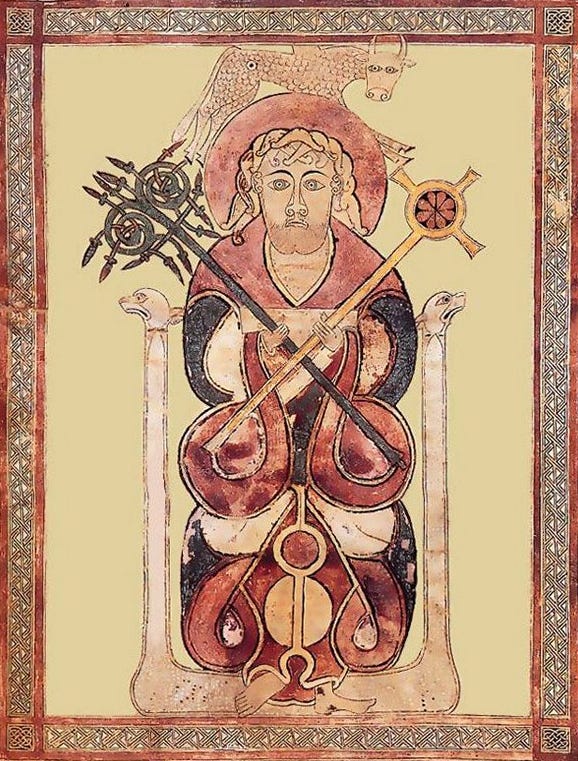
The key event depicted in the MC is an attack on Caer Luitcoed [Lichfield] by the Cyndrwynyn and Morfael: “Before Caer Luitcoed [Lichfield] they caused, blood underneath ravens and severe stirring, Lime-washed shields used to break in front of the fair sons of the Cyndrwynyn”. The establishment of an episcopal seat in Lichfield by the new bishop Saint Chad in 669 shows that by this date the Lichfield-Tamworth area had become the royal core of Mercia. The 8th century illuminated insular manuscript known as Saint Chad’s Gospels or the Lichfield Gospels are of mysterious provenance. They contain puzzling marginalia written in Old Welsh which highlights the mixed cultural influences within Mercia even into later centuries. Saint Chad himself had a Brythonic name which is something we will return to.
Koch believes that Lichfield-Tamworth became the royal core of Penda too. The MC says the Cyndrwynyn “fought for the herds of [the region of] Pennawg”. This “Pennawg” is a region mentioned in poetry relating to Urien Rheged raiding the heartland of Bernicia around Bamburgh and Lindesfarne. The MC continues “They used to drive their spoils back from the distributions of Tame [River Tame i.e. Tamworth], slaves complained; they were hurt; cattle bellowed”. These two lines show that the Cyndrwynyn participated in Penda’s campaigns in Northumbria and were handsomely rewarded for their trouble. Evidently Penda extracted large quantities of spoil during his campaigns which is confirmed by Bede “King Oswiu was exposed to the savage and insupportable attacks of Penda… ...Oswiu was at last forced to promise him an incalculable and incredible store of royal treasures and gifts” and the HB “Oswy delivered all the riches that he had in the city into the hand of Penda, and Penda distributed them to the kings of the British, that is the ‘Distribution of ludeu’.”
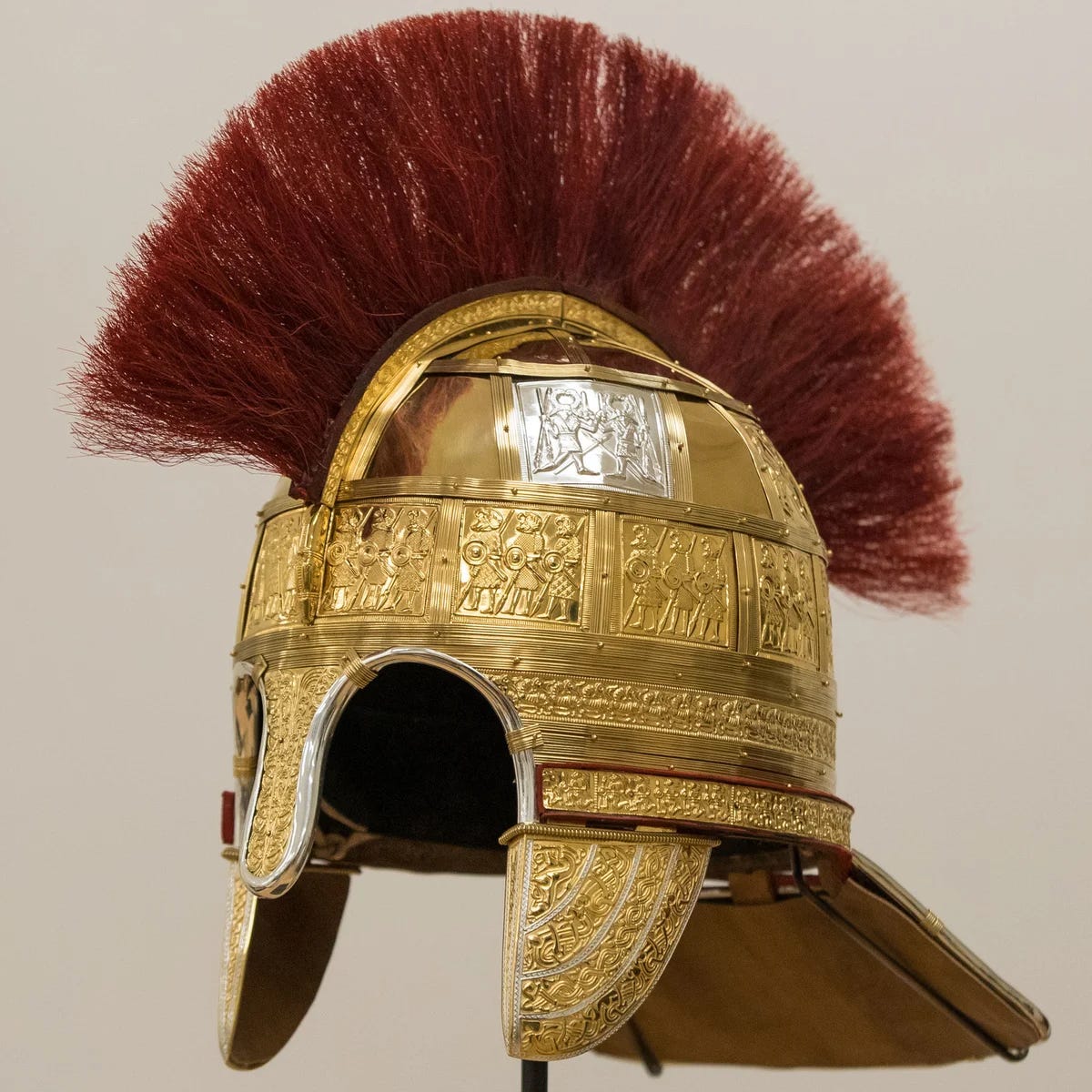
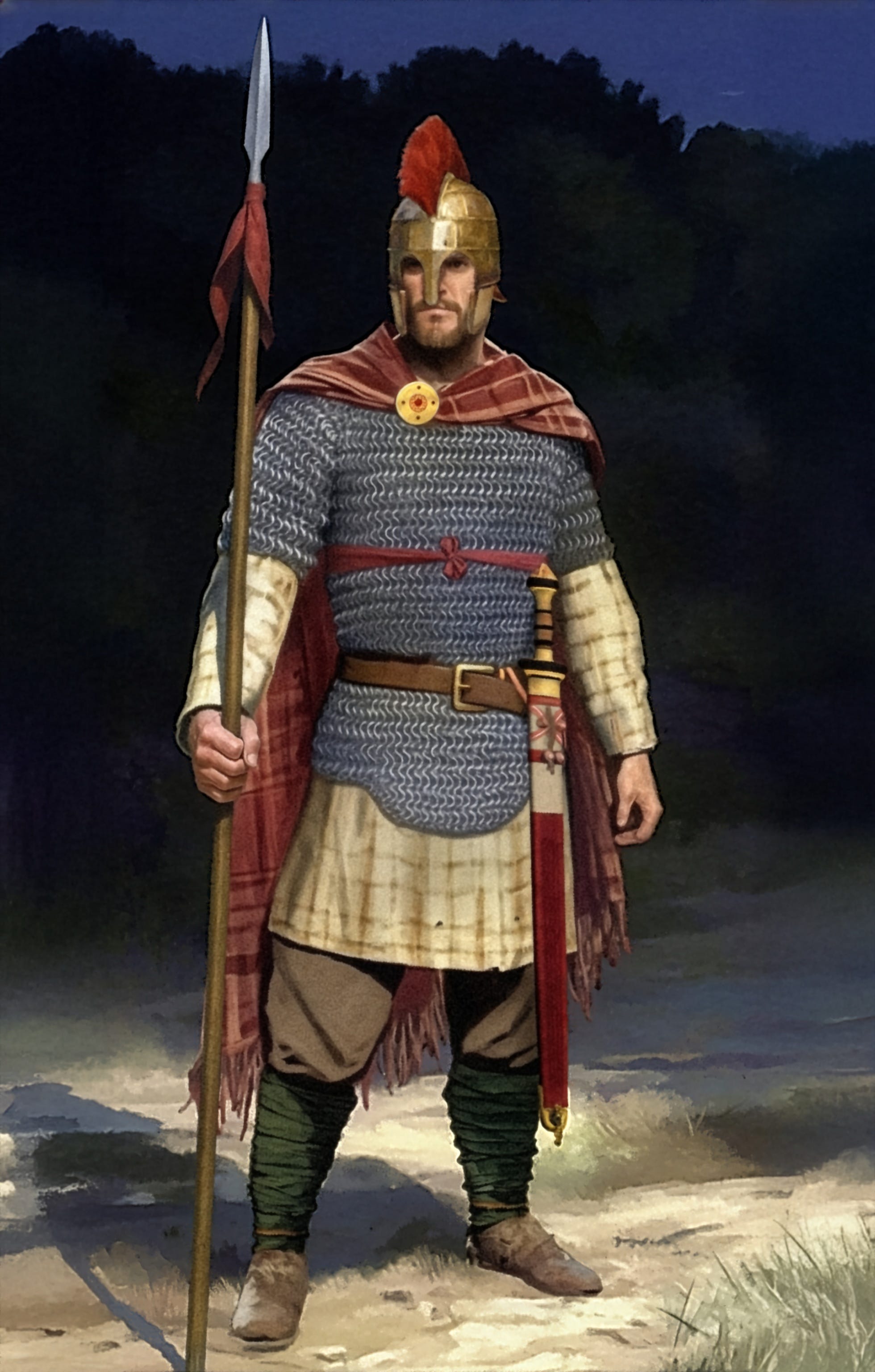
The incredible Staffordshire Hoard contains thousands of pieces of high status metalwork including a helmet, sword pieces and Christian artefacts. It was found very close to Lichfield and as summarised by Historic England: “A combination of investigative conservation, scientific analysis and archaeological and art-historical study suggests that although the hoard objects were buried together, around AD 650-675… ...The late group of ‘Early Insular’ style objects show both Anglo-Saxon and Celtic influences and may originate in Northumbria… ...It is now thought that the items may have been chopped up to create easily distributable bullion that a war leader could use to pay his retinue.” This hoard is almost certainly the spoils won by Penda in Northumbria buried to protect it from the clutches of Oswy post-Winwaed.
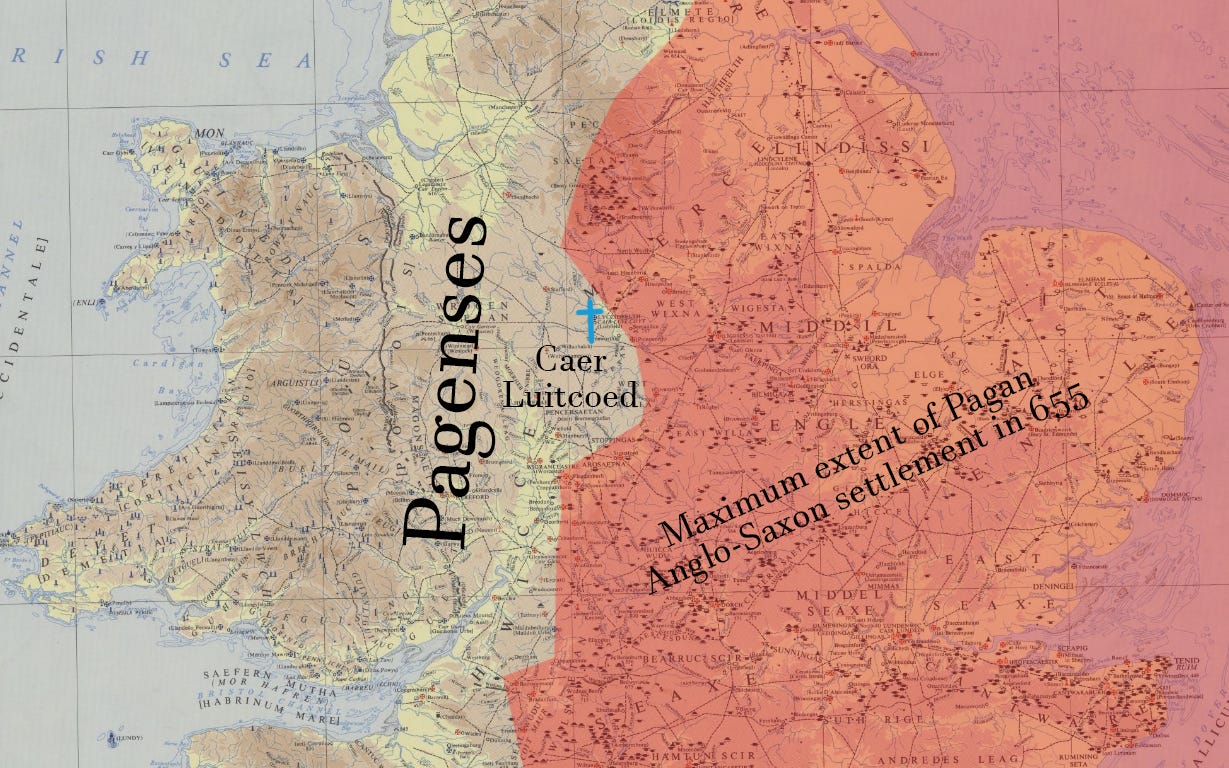
Most scholars place Lichfield (in Latin “Letocetum” or Brythonic “Luitcoit” meaning “Grey Wood”) within the civitas of the Cornouii. There isn’t much evidence but geographically it sits within the West Midlands though on the eastern edge. This means it was probably within the territory of the Cornouii and not the Corieltauvi of the East Midlands. As early Powys [Pagenses] was an overkingdom spanning the entire territory of the Cornouii and Heechan (also with the rest of the Dobunni in Hwicce under Penda) and on the basis of archaeology the Lichfield-Tamworth region was populated by mostly Britons in Penda’s time. According to Bede the Angles of Mercia converted to Christianity from 653. This date is very close to the end of Penda’s reign in 655 therefore the distribution of Anglian Pagan burials in the West Midlands is a good approximation for the ethno-cultural boundary at this date. As illustrated in the figure below (Source: Ordnance Survey Map of Britain in the Dark Ages), Mercia north of the Trent has abundant Anglian Pagan evidence. The Lichfield-Tamworth locality (Staffordshire south of the Trent and west of Tame) has a notable absence of any Anglian Pagan archaeology strongly indicating it was predominantly British in Penda’s time. When looking at the distribution of AS Pagan evidence more broadly it actually seems like the Lichfield-Tamworth region was an outlying eastern British holdout which is entirely the opposite of what would be expected with Bede’s Pagan Penda narrative. However if Penda was a British Christian overlord of Mercia whose heartland lay to the west in Pagenses creating a centre of power in Lichfield on the British side of the Trent-Tame boundary is exactly what we would expect. The fact that half of Penda’s territory was composed of British Christians is completely omitted by Bede. This is either a deliberate omission for propagandistic reasons or Bede was simply unaware.
As outlined by Bede after Oswy killed Penda in 655 he divided Mercia into northern and southern portions. Oswy himself ruled North Mercia above the Trent and Peada ruled South Mercia below the Trent. CoJ adds a third division after “Peada, who had the kingdom of the South Mercians” informing us that “Merewalh, who held the kingdom in the western part of Mercia”. North Mercia held by Oswy above the Trent is easily deduced as roughly Nottinghamshire, Derbyshire and northern Staffordshire. South Mercia held by Peada (including the “Middle Angles”) is roughly Leicestershire, Warwickshire and Northamptonshire. Western Mercia is roughly modern Powys, Cheshire, Shropshire, Herefordshire, Worcestershire, Gloucestershire and south western Staffordshire. This was previously the combined civitates of Cornouii & Dobunni. It also corresponds to the Wreocansaete, Westerna (Magonsaete/ Heechan) and Hwicce of the Tribal Hidage. Western Mercia wasn’t originally Anglian Mercia proper but is in fact synonymous with the British lands of the original Powys [Pagenses] and was Penda’s homeland and stronghold. The fact Morfael is completely overlooked by Bede is probably because he wasn’t recognised as ruling an English kingdom. As Morfael inherited Penda’s core British territory he may have been the oldest son.
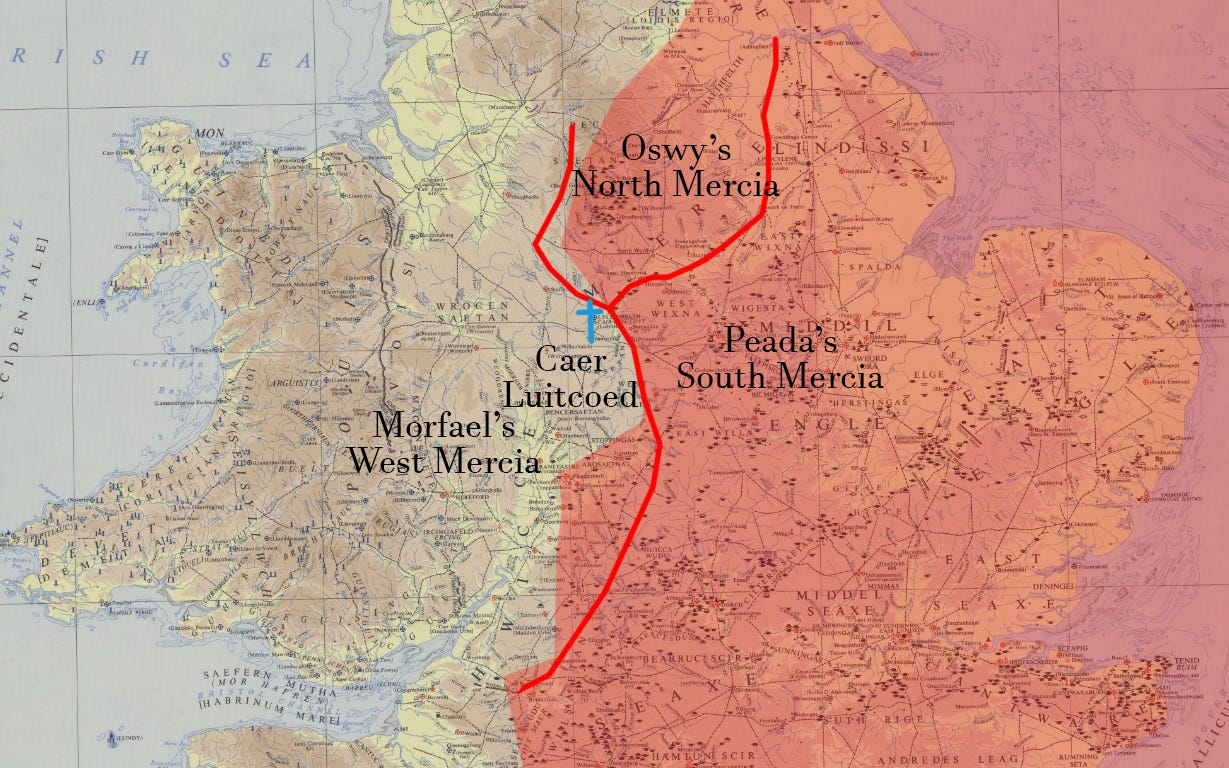
Whilst included in the western British section, Lichfield-Tamworth sits strategically in the centre of the three divisions, which is why it became Penda’s centre of power. It is also why it became the royal core of all Mercia from the late 7th century onwards. The Harleian Genealogies contain an often overlooked dynasty that ruled in Glastonbury claiming descent from “Morfael son of Glast; from whom are the people of Glastonbury, who came from the town which is called Lichfield”. The name “Glast” or “Glas” is unusual and may actually be an epithet meaning “green” or just a confusion of some kind. As Morfael isn’t a common name it seems likely this is the same Morfael son of Penda king of Pagenses [West Mercia] depicted attacking Lichfield and corroborates Lichfield was within his inherited territory. There is further evidence that British cousins of Penda’s dynasty were based in Lichfield too which we shall return to.
After the death of Peada in 656 Oswy seized direct rule of Southern Mercia. As recorded under the corrected year 656 in the Annales Cambriae “Oswy came and took plunder”. Oswy invaded the lands of Morfael annexing the Lichfield-Tamworth region and launched devastating raids further into Cynddylan’s subkingdom of Pengwern around Wroxeter. This is the historical context upon which Marwnad Cynddylan (MC) should be analysed.
My own preferred translation of the critical lines of MC reads: “The enormity of the sword fighting! Great spoils! It was before Caer Luitcoed [Lichfield] that Morfael [Merewalh] led away, Fifteen hundred cattle and five bondsmen, eighty horses with noble trappings, the dead archbishop in his square tomb, did not protect the book grasping monks, who fell in their enclosure of gore at the hands of the shining captain.” This attack by Morfael on Lichfield was an attempt to drive out the Northumbrian invaders. Morfael was trying to emulate the successful defences by previous rulers of Powys [Pagenses], namely the successful campaign of Cadwallon and Penda driving Edwin out of Powys at Cefn Digoll; Penda killing Oswald at Maes Cogwy but also Selyf against Aethelfrith at Chester. One problem is that there was certainly no archbishop [pen esgob] in Lichfield 656. Saint Chad didn’t establish the episcopal seat of a bishop there until 669. Koch solved the puzzle by suggesting this is a rhetorical flourish recalling the slaughter of the monks of Bangor at the battle of Chester. Bede wrote “the prophecy of the holy Bishop Augustine was fulfilled… ...namely that those heretics (insular Christian Britons) would also suffer the vengeance of temporal death”. Saint Augustine was the first Archbishop of Canterbury. These lines assert that it is only through the martial strength of Morfael that the interests of Christian Britons can be protected from Northumbrian attacks.
As Koch writes one purpose of the MC was “a diplomatic effort seeking Gwynedd to join forces with Morfael”. Invoking the slaughter of the British monks at the hands of Northumbria was still an evocative unifying memory in Wales. It is thought that king of Gwynedd Iago ap Beli, Gwion ap Cyndrwyn (Cynddylan’s brother) died alongside the king of Powys (and High King of the Britons) Selyf ap Cynan fighting at Chester. Meugan the composer of this rhetoric was clearly a Welsh Christian court bard under the patronage of Morfael. Meugan was depicting Morfael as the inheritor of this legacy as great protector of the Britons and the insular British church. The clear implication is that Morfael himself was a devout British Christian.
Morfael was not successful in his bid to rally the kings of the Britons behind him to drive Oswy out of Mercia and once again assert Pagenses overlordship of Mercia. Instead his brother Wulfhere, who had been incubated by the ealdormen of Anglian Mercia, became the dominant king of Mercia driving out Oswy. Morfael submitted to his brothers rule at which point his domain of Western Mercia began to rapidly Anglicise including his marriage to a Kentish princess and induction into the English church in 660.
The significance of the conclusion that prior to 660 Morfael was a devout insular British Christian shouldn’t be understated. As previously demonstrated it is quite clear from British sources that Penda was considered the king of Powys [Pagenses] not Anglian Mercia and his son Morfael was considered a British Christian inheritor of this territory. If Morfael was a British Christian then the probability that his father Penda was also greatly increases. It also makes it credible that Bede’s constant assertion of Penda’s unparalleled Paganism was a simple misunderstanding of a written source stating “Penda rex Pagenses”. The literal meaning of Pagenses “people of the rural districts” was adopted as the name for Powys but also meant Pagans. Penda was known as king of Pagans but British Christian ones.
Cadwalla, Chad and Cadfan Luitcoed
To emphasise the fallibility of Bede when it comes to accurately portraying religious affairs we will look at another “young and vigorous prince of the Gewisse” called “Caedwalla” and his ancestors. Caedwalla possessed an overtly Brythonic name “Cadwallon” (meaning “Battle ruler”) and was sometimes confused with his predecessor and namesake king of the Britons Cadwallon. After Caedwalla became King of Wessex he successfully installed his brother “Mul” as ruler in Kent. The name “Mul” was probably an epithet derived from the Latin “Mulus” meaning “Mule”. This has often been taken as an allusion to a mixed Anglo-British ethnic origin for “Mule” and his brother Caedwalla. The previously discussed origin of the Gewisse-Glewis dynasty would dovetail with this idea neatly.
Curiously most sources claim Caedwalla was the last Anglo-Saxon Pagan ruler. For example a land grant recorded by WoM says “Caedwalla consenting and confirming with his own hand, although he was a pagan granted Lantocai”. Bede writes “After Caedwalla had gained possession of the kingdom of the Gewisse he also captured the Isle of Wight, which until then had been entirely given up to idolatry, and endeavoured to wipe out all the natives by merciless slaughter and to replace them by inhabitants from his own kingdom, binding himself, or so it is said, by a vow, though he was not yet Christian, that if he captured the island he would give a fourth part of it and of the booty to the Lord. He fulfilled his vow by giving it for the service of the Lord to Bishop Wilfrid”. Bede makes it clear the destruction of the Isle of Wight dynasty marked the end of Anglo-Saxon Paganism at least amongst the aristocracy: “saved were two young princes, brothers of Arwald, king of the island… ...When the enemy was approaching the island they escaped by flight and crossed over into the neighbouring realm of the Jutes… ...The abbot asked the king [Caedwalla] whether, if the boys must needs be killed, they might first be instructed in the mysteries of the Christian faith. The king agreed… ...When the executioner arrived, they gladly submitted to temporal death through which they were assured that they would pass to the eternal life of the soul. In this way after all the kingdoms of Britain had received the faith of Christ, the Isle of Wight received it too”.
The Life of Bishop Wilfrid (LoBW) asserts Caedwalla was a committed student and spiritual son of the Bishop: “there came a certain exile of noble descent from the desert places of Chiltern and the Weald whose name was Ceadwalla. He earnestly asked for the friendship of our holy father, praying Wilfrid to be his faithful father, to teach and help him, while he, on his side, promised him with a vow that he would be an obedient son. This compact, which they undertook with God as their witness, was faithfully fulfilled” and “King Caedwalla in his victory rewarded him [Bishop Wilfred] with innumerable pieces of land and other gifts out of the love of his heart and for God’s sake, and honoured his father exceedingly”. All sources agree that Caedwalla abdicated the throne and received baptism whilst on pilgrimage to Rome in 689 and died shortly afterwards.
Colgrave commenting on this contradictory information says “Wilfrid’s association with this bloodthirsty young pagan as described by Eddius is difficult to explain”. Caedwalla is simultaneously depicted as a non-Christian Pagan and a committed servant of Christian interests wiping out the last Pagans. This square could be circled if Caedwalla was in fact a practitioner of insular British Christianity. It is quite clear from the information supplied to us by Bede and LoBW that Caedwalla was only baptised in the Romanist Christian tradition at the end of his life in Rome and that during his life he performed the actions of a committed Christian ruler. It is also clear that with a British name like “Cadwallon” he was under some British cultural influence. The notion Caedwalla was “not yet Christian” could have stemmed from the fact his recorded Romanist baptism was at the end of his life. Wilfred was well known for his role in persuading the kings of Northumbria to convert from insular Celtic Christianity to the Romanist tradition. If Caedwalla began life as an insular British Christian but under the influence of Wilfred converted to the Romanist church it would explain why he acted as a Christian throughout the duration of his rule but has a post-rule Romanist baptism recorded. Bede’s assertion that Caedwalla was a Pagan cannot be considered reliable. If Caedwalla was incorrectly labelled a Pagan by Bede it is also possible Penda king of Powys [Pagenses] was a similar confusion.
Investigating the early life and ancestry of Caedwalla provides further clarity on this topic. According to Bede Wessex had first converted to Christianity under Cynegils (Cynglas) and his son Cenwalh (Cynfael). As LoBW says Caedwalla (Cadwallon) was an “exile of noble descent from the desert places of Chiltern”. Blair has demonstrated that the Chiltern region or “Cilternsaete” was ruled by a Mercian subking at this time. It may be therefore that Caedwalla was ruling this subkingdom of Mercia in exile. Mercia was also largely converted to Christianity at this time. It seems highly unlikely that an exile of the Christianised Gewisse in the Christianised Mercia with a British name would be an Anglo-Saxon Pagan.
The ASC lists Caedwalla (Cadwallon) as son of Coenberht (Brythonic Cynbryd?) son of Ceadda (Chad) son of Cutha (Cathuan) son of Ceawlin (Caw) son of Cerdic (Ceredic). Another pedigree lists a Cynebald son of Cuthwin son of Ceawlin. While the pedigrees in the chronicles are somewhat confused at times Cutha is usually taken as a hypocoristic version of the name Cuthwin. To confuse matters further Ceawlin seems to have had a son and a brother both named Cutha/ Cuthwin. To summarise, Ceadda and Cynebald were sons of Cuthwin who was son of Ceawlin son of Cerdic. There is nothing known about this “Ceadda”, the only other individual with this name in this period was Saint Chad (Ceadda is an alternate spelling of Chad). Ceadda or Chad is another hypocoristic form from the Brythonic element “Cad-” meaning “Battle”. It is a shortened form of a name like “Cadwallon” or “Cadfan”.
In late 7th century Northumbria Bede informs us “There were then four brothers whom we have mentioned, Cedd, Cynebil, Caelin and Chad, who were all famous priests of the Lord, a very rare thing to happen, and two of them reached the rank of bishop”. Interestingly these four very influential brothers seem to possess Brythonic names, Bede confirms elsewhere that the name Caelin is an alternate spelling of Ceawlin: “Caelin, king of the West Saxons, known in their own language as Ceawlin”. Bede omits any mention of their parentage or background but does specify Chad “was one of Aidan’s disciples and sought to instruct his hearers in the ways and customs of his master and of his brother Cedd”. Only Chad is specified to have learned directly from Saint Aidan who was the first Bishop of Northumbria. Cedd was older than Chad and also advocated for the insular Celtic tradition. Cedd lead the first mission to Mercia after he was requested by Peada. Bede even states “King Penda did not forbid the preaching of the Word, even in his own Mercian kingdom, if any wished to hear it”. This in itself undermines the notion that Penda was a devout bulwark of Paganism. This mission to convert the Pagan Angles occurred at the request of Peada with their overlord Penda’s blessing. As we shall see Cedd was actually second cousins with Penda which is probably why he was chosen to lead this mission. Cedd later lead another mission to convert the kingdom of Essex whereupon he was ordained as their Bishop in the insular Celtic tradition. Bede informs us that Cedd built the stone Chapel of St Peter-on-the-Wall in Essex which amazingly still stands to this day.
Bede relays how the influential brothers acquired a monastery for themselves: “This king [Aethelwald son of Oswald] had previously had with him Caelin, Cedd’s brother, a man equally devoted to God… ...for he was a priest. It was through him chiefly that the king had got to know and had learned to love the bishop [Cedd]. So, in accordance with the king’s desire, Cedd chose himself a site for the monastery… ...The man of God was anxious first of all to cleanse the site… ...he asked his own brother Cynebil, who was a priest, to complete the sacred task. The latter gladly agreed and, when the work of fasting and prayer was ended, he built a monastery now called Lastingham and established in it the religious observances according to the usage of Lindisfarne where he had been brought up…...governed after him by his brother Chad who was afterwards consecrated bishop as we shall hear later”. Cedd argued for the interests of the insular Celtic church at the Synod of Whitby and importantly “acted as a most careful interpreter for both parties at the council” suggesting he was uniquely multi-lingual.
Despite the pro-Romanist result of the Synod of Whitby and the episcopal seat of Northumbria being promised to Saint Wilfred, King Oswy seems to have changed his mind and instead chose to install Saint Chad, according to Bede: “King Oswy… ...sent a holy man… ...to be consecrated bishop of the church of York. This was a priest named Chad, brother of the most reverend Bishop Cedd, who has often been mentioned and abbot of the monastery of Lastingham… ...they went to the kingdom of the West Saxons where Wine was bishop. The latter consecrated Chad with the assistance of two bishops of the British race who as has repeatedly been said, keep Easter Sunday, according to their rule”. Bede later retells how Chad was ousted from his position by Archbishop Theodore for being ordained by two British bishops: “he made it clear to Bishop Chad that his consecration had not been regular, whereupon the latter humbly replied, ‘If you believe that my consecration was irregular, I gladly resign from the office…’ ...When Theodore heard his humble reply, he said that he ought not to give up his office; but he completed his consecration a second time after the catholic manner”. The LoBW expands upon this incident further: “King Oswy… ...at the instigation of the ancient foe [insular Celtic church], consented to allow another to forestall him in his see in an irregular manner; for he was instructed by those who adhered to the Quartodeciman party [insular Celtic tradition] in opposition to the rule of the Apostolic See [Romanist]; they consecrated to the See of York a deeply pious servant of God and admirable teacher named Chad… ...they did it ignorantly and in defiance of canon law… ...he [Theodore] heard from the lips of true witnesses the story of the offence against the canon law… ...He indignantly ordered that Bishop Chad should be deposed… ...Chad, being a true and meek servant of God and fully understanding then the wrongdoing implied in his ordination to another’s see by the Quartodecimans [insular Celtic church]… ...whereupon Theodore, with Chad’s consent, installed St Wilfrid as bishop in his own see of York.”
The church of the Britons and the Irish were essentially a unified entity, hence the phrase “insular Celtic church”. The Irish Bishop Cummian highlighting this wrote “Rome is mistaken; Jerusalem is mistaken; Alexandria is mistaken; Antioch is mistaken; the whole world is mistaken: the Britons and the Irish alone hold the truth”. This is because the Irish were converted by British missionaries like Patrick and Uinniau and modelled their practices on the British church. Bede asserts the Britons had no influence in the conversion of the Anglo-Saxons and minimises the role of the Irish in order to reinforce the primacy of the Romanist tradition. There are reasons to doubt this version of events such as the claimed role of Rhun of Rheged in the baptism of Edwin king of Northumbria. The consecration of Saint Chad by two British bishops in Wessex is another reason to doubt this narrative. Firstly it tells us that British Christianity was prominent if not dominant within the kingdom of Cenwalh (Cynfael) in Wessex. Cenwalh is also credited in a charter with the foundation of a monastery called “Lanprobi” (Sherborne) from Brythonic “Llan Probus” meaning “Church of St Probus” further suggesting Cenwalh was involved with the British church. Chad specifically chose to be consecrated by British bishops amongst the Gewisse-Glewis which might allude to his identity, origin and brand of Christianity. This brand of Christianity was not only prominent in Wessex but via Bishop Chad and his brother Bishop Cedd also prominent in Northumbria, Essex and Mercia.
According to Bede after reconsecration in the Romanist tradition “Chad accepted the position of bishop of the Mercian race… ...He had his episcopal seat at a place called Lichfield, where he also died and was buried, and where the succeeding bishops of the kingdom have their see to this day”.
Noting the prominence of alliterative C names in the Cerdicing dynasty (Cerdic, Cynric, Ceawlin, Cynegils, Cenwalh etc) it is tempting to see a connection to the alliterative C names of Chad, Cedd, Caelin (Ceawlin) and Cynbil. The rare name “Ceawlin” by itself suggests a dynastic connection to the Wessex Ceawlin, only attested in these two persons. As Bede omits any details about the parentage of Saint Chad (Ceadda) it is also tempting to speculate that he is the same person as the grandfather of Caedwalla, namely Ceadda son of Cuthwin son of Ceawlin son of Cerdic. This theory is loosely supported by the fact Ceadda son of Cuthwin has a recorded brother called Cynebald which is arguably an equivalent variant spelling to the brother of Saint Ceadda called Cynbil (Brythonic Cynbelyn?).
The strongest piece of evidence in support of this idea comes from the Welsh “Bonedd Y Saint” which lists a Saint “Ceada o Redynvre ap Cadfan Llwytgoed” or “Saint Chad of Farndon son of Cadfan of Lichfield” where Farndon is a reference to St Chads Church in Farndon, Cheshire (Formerly Powys). The Brythonic name “Cadfan” has multiple variant spellings including “Cadwan” and “Cathuan” in English sources. This confirmation that Saint Chad was son of a Cathwan is clearly the same name as the Ceadda son of Cuthwin listed as the grandfather of Caedwalla. Cuthwin is an Anglicisation of the Brythonic name Cathuan or Cadfan. If this identification is accepted it would have some significant implications. It is tempting to see a connection to the “Llangadfan” (Church of Cadfan) in northern Powys although there is no evidence. Incidentally Ceredic ap Alauc has a documented brother also named Cadfan.
Taking at face value the epithet assigned to Cadfan in ByS “Llwytgoed” means that the family resided in Lichfield in the generation before Chad established the episcopal seat of Mercia in the same location. An 11th century document “On the Resting-Places of the Saints” asserts that not only was Saint Chad buried at Lichfield but his brother Saint Cedd too. Evidently there was a strong familial connection to Lichfield. After Ceawlin King of Wessex was defeated in battle in 592 the ASC tells us that he was briefly exiled to an unspecified location before he died. Logically by extension his son Cuthwin or Cadfan was exiled too. The ByS suggests the location of this exile was Lichfield which at the time was within Powys [Pagenses] under the overlordship of King Selyf ap Cynan Garwyn. If we factor in that Chad was son of a “Cadfan” and grandfather of a “Cadwallon” his hypocoristic name containing the same “Cad-” element was probably a diminutive form of “Cadwallon”. We can rule out “Cadfan” as he wouldn’t possess the same name as his father but as names often recur in dynasties “Caedwalla” was probably named after Chad. Use of the shortened form is understandable given the King of Britons “Cadwallon” had ravaged Northumbria within living memory. Oswy appointing a bishop named after a war criminal wouldn’t have gone down very well thus the diminutive “Chad” was used instead. If Saint Chad’s full name was “Cadwallon ap Cadfan” this could explain a further historical conundrum. Traditionally the king of the Britons that killed Edwin at Hatfield Chase in 633 was also called Cadwallon ap Cadfan. Without expanding upon it here this tradition has been refuted by Woolf who claims King Cadwallon was actually son of a northern king in the Hen Ogledd called “Guitcun”. This will be discussed in an upcoming article. If Woolf is correct then a factor that may have contributed to this confusion in Welsh tradition is the existence of a second contemporary Cadwallon ap Cadfan in Lichfield. Some writers such as Geoffrey of Monmouth and Reginald of Durham also assert that whilst King Edwin was in exile he grew up alongside Cadwallon ap Cadfan which initiated a rivalry between the pair. Whilst there is no good evidence Edwin was ever exiled in the court of Gwynedd, as previously discussed there is evidence Edwin was exiled in Mercia-Powys under the overlordship of Selyf of Powys. It is therefore very plausible Edwin spent some time in Lichfield alongside Cadwallon ap Cadfan (Saint Chad). This may even explain how Saint Chad and his brothers ended up in Northumbria if they were taken as elite hostages after the defeat of Selyf by Aethelfrith. This elite provenance would explain their prominence within the Northumbrian church especially if they were amongst the few practising insular Celtic Christians within the aristocracy of Pagan Northumbria when Oswald took the throne.
One objection to equating Saint Ceadda son of Cathwan with Ceadda son of Cuthwin is that the clergy usually didn’t marry and procreate. Whilst it was often overlooked clergy often did produce offspring, for example in the insular Celtic church Saint Patrick himself records himself descending from a lineage of clergy his father was “Calpurnius, a deacon, son of Potitus, a priest”. Another example from the Romanist Northumbrian church as Symeon of Durham writes “Bishop Aldun had given his daughter, named Ecgfrida, in marriage to Gospatric’s son”. Clearly being a member of the clergy didn’t always mean no offspring.
If it is accepted that Cadfan son of Ceawlin went into exile in Lichfield in Powys [Pagenses]; that his son Saint Chad later setup the episcopal seat of Mercia in the same location and that Saint Chad was grandfather to Caedwalla then it is highly unlikely that Caedwalla himself was a Pagan. Caedwalla may have even been associated with the Pagenses in some way. It is more likely that Caedwalla was practising a brand of insular Celtic Christianity that survived within British Western Mercia and that his early presence amongst the Cilternsaete was as a ruling subking under Aethelred son of Penda. Therefore Bede was mistaken in asserting Caedwalla was a Pagan prior to his Romanist baptism. This fallibility demonstrates that Bede could be similarly mistaken about the religious affiliations of Penda rex Pagenses.
It is briefly worth noting two other persons affiliated with Saint Chad and his brothers. The first is a disciple of Chad mentioned by Bede called “Owine” which is another overtly Brythonic name “Owain”. This Owine was the sole witness “who saw the soul of Chad’s brother Cedd descend from the sky with a host of angels and return to the heavenly kingdom, taking Chad’s soul with him”. We are not told much about Owine’s background except “He had come with Queen Aethelthryth [to Northumbria] from the kingdom of the East Angles, being the chief of her officers and the head of her household”. The second person of note is the famous poet “Caedmon” who also has a Brythonic name “Cadfan”. Caedmon was a member of the Northumbrian clergy in the monastery of Whitby nearby to Cedd and Chad’s monastery of Lastingham. Bede relates that Caedmon was a uniquely divinely inspired poet who received his gift while dreaming: “he left the place of feasting and went to the cattle byre, as it was his turn to take charge of them that night… ...he [Caedmon] stretched himself out and went to sleep, whereupon he dreamt that someone stood by him, saluted him, and called him by name: ‘Caedmon,’ he said, ‘sing me something.’ Caedmon answered, ‘I cannot sing; that is why I left the feast and came here because I could not sing.’… ...Caedmon began to sing verses which he had never heard before in praise of God the Creator… ...When he awoke, he remembered all that he had sung while asleep… ...In the morning he went to the reeve who was his master, telling him of the gift he had received”.
This account of how Caedmon received the gift of divinely inspired poetry is very similar to two Welsh accounts, firstly Giraldus Cambrensis writes “There are certain persons in Cambria, whom you will find nowhere else, called Awenyddion, or people inspired; when consulted upon any doubtful event, they roar out violently, are rendered beside themselves, and become, as it were, possessed by a spirit… ...These gifts are usually conferred upon them in dreams: Some seem to have sweet milk or honey poured on their lips; others fancy that a written schedule is applied to their mouths and on awaking they publicly declare that they have received this gift.” Henry Vaughan wrote a similar account “This vein of poetrie they called Awen, which in their language signifies rapture, or a poetic furor… ...[Bards are] gifted or inspired with it… ...there was a young lad… ...that kept a great stock of sheep upon the mountains… ...There in Summer time following the sheep and looking to their lambs, he fell into a deep sleep in which he dreamt, that he saw a beautiful young man with a garland of green leafs upon his head, and a hawk upon his fist: With a quiver full of Arrows at his back, coming towards him… ...at last let the hawk fly at him, which (he dreamt) got into his mouth… ...suddenly awaked in a great fear and consternation: But possessed with such a vein, or gift of poetry, that he left the sheep and went about the Country, making songs upon all occasions, and came to be the most famous Bard in all the Country in his time”.
There is some clear similarities between these accounts of British bards and Caedmon both being gifted with divine inspiration whilst dreaming in proximity to livestock. As Brythonic names were not common within the kingdom of Northumbria it is curious to see a “Caedmon” living roughly a generation after Chad and Cedd in close proximity to their family monastery of Lastingham. On top of this he also has an alliterative C name, and not insignificantly the same one as Chad’s father Cadfan. It is a reasonable speculation that Caedmon was another son of one of these brothers.
Bede does cryptically mention an unnamed son of Cedd that became a member of the clergy. The context of the passage does make it clear Bede means a spiritual son but this could be obscuring biological parentage: “another attack of the pestilence came upon them and they all died, with the exception of one small boy who was preserved from death by the intercession of Cedd his father… ...afterwards admitted to priest’s orders, rendering useful service to many in the church. I do not doubt that he was delivered from the jaws of death by the intercession of his father Cedd”. It is in no way implied this spiritual son of Cedd could be Caedmon but it hard to imagine there isn’t some connection between these contemporary persons with rare Brythonic names. Similarly it isn’t coincidental that Chad’s closest disciple Owine had a Brythonic name, this may be concealing another familial relationship. It is also possible Caedmon and Owine were simply attracted to the orbit of Saint Chad’s influential family because they were fellow Anglo-Britons.
Conclusion
This article was in some sense an exercise in Brythonic maximalism but when taken cumulatively the mass of evidence points to strong British influence within the early kingdoms of Wessex, Mercia and beyond. It is probably more accurate to view this dynasty not as Anglo-Saxon nor British but Anglo-British. If the patrilineal descent from Vortigern to Cadell Deyrnllug, Ceredic ap Alauc, Creoda of Hwicce, Penda of Pagenses to Saint Chad and his grandson Caedwalla of Wessex is accepted it is a testament to the incredible resilience and dynamism of this ancient aristocracy even in the face of total cultural change.
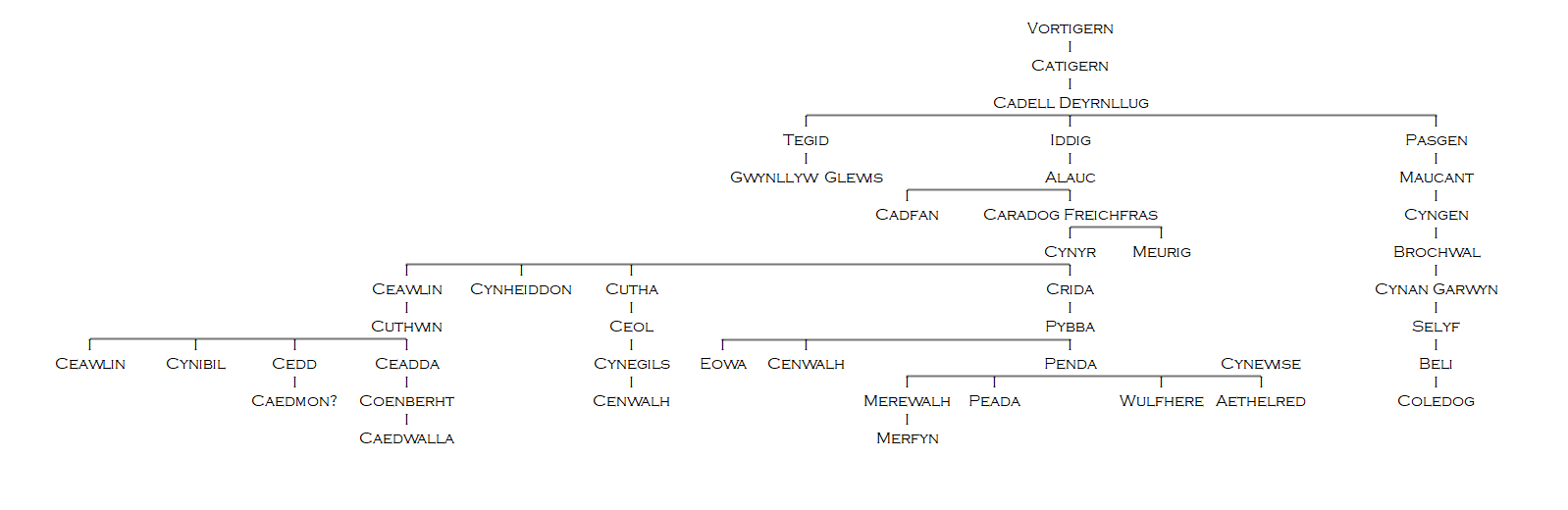
Gem alert
Wow, great read! Penda and Cadwallon are fascinating, and I’ve been wanting to learn more about their ruling dynasties and origins. Thanks for sharing!