

Note from Aurochs: My friend p5ych0p0mp has produced another massive article, this time looking at some peculiarities surrounding Cerdic. This will be a massive two part article, so wrap your head around the first part, and next week I’ll publish the second.
The British Origins of English Kings
Introduction
The Kingdom of England emerged from a dominant Kingdom of Wessex ruled by Alfred the Great and subsequently his grandson Athelstan. The origins of this dynasty are crucial to anybody seeking to understand the history of Britain.
Nearly two thousand years ago, during the Roman conquest of Britain, the resistance effort was valiantly lead by the King of the Britons named Caratacus. The Brythonic name “Caratacus” (karatus + akos) means “beloved”. As a result of the ancient and heroic fame of Caratacus his name found frequent use amongst early medieval British kings such as Ceretic Guletic, the founder of the Strathclyde dynasty and correspondent of Saint Patrick. Another ruler of this name was Ceredic ap Gwallog mentioned in sources such as the Welsh Triads. This Ceredic was a ruler of the northern British Kingdom of Elmet and was mentioned by Bede “rege Brettonum Cerdice” “Cerdic King of the Britons”. This example clearly shows how the Anglicised spelling of “Ceredic” is “Cerdic”.
To prove their legitimate pedigree the Kings of Wessex traced their ancestry back to their legendary founder also named “Cerdic”. The founder of the most prestigious Anglo-Saxon dynasty holding a Brythonic name has long puzzled many historians, with many passing comment but not many attempting a deeper investigation. Cerdic had numerous descendants, Kings of Wessex, who also had Brythonic names. This article will outline an explanation for the origins of Cerdic including further implications for the equally curious early Kings of Mercia.
The main source for details on Cerdic and his descendants is the Anglo-Saxon Chronicle (ASC). The earliest relevant entry dating to 495 reads “In this year came two aldormen to Britain, Cerdic and Cynric his son, with five ships, at the place which is called Cerdic’s Shore; and on the same day fought against the Welsh.” This narrative is immediately suspect as no fresh off the boat Germanic warlord would have an unambiguously Brythonic name like Ceredic. Analysis of these early often contradictory entries in the ASC relating to Cerdic have produced a general consensus that “the fifth and sixth century dates were extremely unreliable and had been artificially extended to make it appear that the kingdom was founded at an earlier date than was actually the case”. Dumville concluded by comparing the ASC with the West Saxon Genealogical Regnal List (WSGRL) that Cerdic’s floruit was in fact the 530s.
The ASC also portrays the original core of Wessex as southern Hampshire and the Isle of Wight region. This is in direct contradiction to the reliable narrator Bede who tells us that this region was an independent Jutish province until his lifetime when it was conquered by the West Saxon King Caedwalla in 686. Incidentally Caedwalla was the last king of Wessex with an unambiguously Brythonic name “Cadwallon” (Catu + walos) meaning “Battle Ruler”. The high frequency of “Cerdic” place names in the early ASC entries also points to a reverse engineered narrative based on spurious folk traditions.
As Yorke summarises, the later ASC entries relating to Ceawlin in the late 6th century “do not suffer from the same problems of credibility” as those relating to his father Cynric and grandfather Cerdic. Plotting the locations of places mentioned in the Ceawlin entries indicates the early core of the kingdom was the upper Thames valley. This conclusion is reinforced by Bede: “At that time, the West Saxons, formerly called Gewisse, in the reign of Cynegils, received the faith of Christ… ...The two kings (Cynegils & Oswald of Northumbria) gave to the bishop the city called Dorchester, there to establish his episcopal see”. In addition to this ecclesiastical evidence the Dorchester-on-Thames and Abingdon region of the upper Thames valley have produced plentiful archaeological evidence for early Saxon settlement.
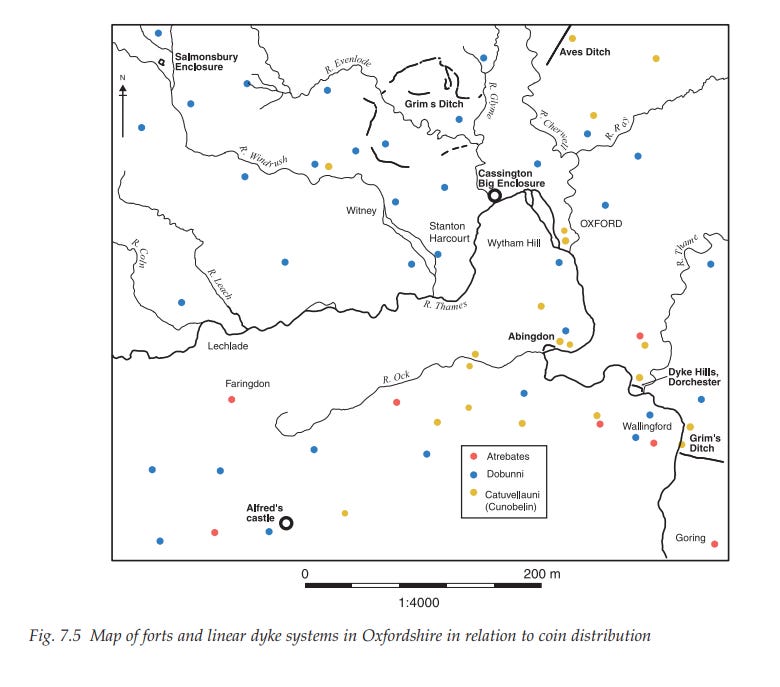
Dorchester-on Thames sits on the boundary between the pre-Roman tribes of the Dobunni and Catuvellauni as illustrated by the distribution of iron age coinage shown in the figure below. This corresponds to the border between Roman period civitates and provinces. Generally speaking during the Sub-Roman period the south western former province of Britannia Prima was heavily populated by Britons whilst the south eastern former province of Maxima Caesariensis was heavily populated by Anglo-Saxons. As the early core territory of Cerdic’s kingdom sits roughly on the geographical interface between these two ethnic blocs it becomes clear that the origins of the “Gewisse” may be more nuanced than the early ASC entries portray.
In summary precious little can be said for certain about the origins of Cerdic’s dynasty other than its early rulers have Brythonic names (which we will discuss in greater detail later); Cerdic’s floruit was in the 530s; their “tribe” were known as the “Gewisse” until Caedwalla; they emerged from an inland political and ethnic boundary (Gloucestershire-Oxfordshire area) and not from a southern Germanic coastal conquest. This is generally the current academic consensus and is the starting point for further inquiry.
Gewis and Glewis
The first clue to the origins of Cerdic’s dynasty comes from Bede who tells us “Caedwalla, a young man of great vigour, of the royal race of the Gewisse” and that “the West Saxons, formerly called Gewisse”. It is quite clear from these statements that “Gewisse” is an ethnonym for their tribe but not necessarily a place or personal name. Why this “royal race” with Brythonic names like Ceredic and Cadwallon felt the need to rebrand to a more overtly Germanic “West Saxons” is unclear, but distancing themselves from a Brythonic origin cannot be ruled out.
The name “Gewis” or “Giwis” appears in all versions of Cerdic’s pedigree in the position of his grandfather. Sisam studied these pedigrees and by comparing Bernicia with Wessex concluded that prior to Cerdic they were both identical genealogies with the exception that in place of “Gewis” in the Bernician pedigree is “Beornic”. This eponymous ancestor figure “Beornic” giving his name to the kingdom of Bernicia is reflected by the eponymous ancestor figure “Gewis” giving his name to the “Gewissae”. The name “Beornic” and “Bernicia” itself has been demonstrated to actually derive from the older Brythonic predecessor kingdom “Bryneich” meaning “Land of the Gaps”. This Brythonic “Berneich” was reinterpreted as an eponymous founder by the later Anglian people. As Sisam suggests it is generally believed that “Gewis” fulfils a similar role in the Gewisse pedigree and was not a real historical ancestor of Cerdic but mimicking Bernicia was inserted as a mythical founder figure.
There is little else in any other English source to tell us the origin of the terms “Gewis” or “Gewisse”. It is most commonly accepted, as outlined by Coates, as a “nominalisation of the adjective gewis”. This adjective is from the Old English “gewiss” meaning “sure, known, certain”. This is a neat and likely the correct solution but before it is considered case closed it is worth looking at some Welsh sources. It is also worth noting that Old English “gewiss” meaning “known” is cognate with the Brythonic “gwis” also meaning “known”. This “Gewis” or “Gwis” could be a useful mutually intelligible term (denoting known, sure, certain or reliable allies) if as some have suggested the Gewisse were a British aristocracy using Saxon federates.
One medieval writer called Alanus de Insulis explicitly called the Gewisse “a people of the Britons” although this statement seems to be based on the highly dubious authority of Geoffrey of Monmouth (GoM).
In the pre-Galfridian Historia Brittonum (HB) Nennius recites Vortigern’s pedigree culminating in the eponymous ancestor figure “Gloui”. Nennius continues “...four brothers, who built Gloiuda, a great city upon the banks of the river Severn, and in British is called Cair Gloui, in Saxon, Gloucester. Enough has been said of Vortigern.” The real etymology of Gloucester is from the Brythonic “gloyw” meaning “shining”. The takeaway point here is that Welsh tradition placed Vortigern’s dynasty and centre of power at Gloucester which was believed to be named after an eponymous ancestor “Gloui”.
In Historia Regum Britanniae (HRB) GoM modifies this tradition somewhat. He claims the legendary King Arviragus married a daughter of the Emperor Claudius: “She was named Gewissa… ...After they were married… ...he suggested to Claudius that they build there a city to perpetuate the memory of so happy a union. Claudius agreed and ordered the construction of the city, named Kaerglou, or Gloucester… ...Others claim that it took its name from Claudius’ son duke Gloius”. Due to scribal error and interpretation variant spellings “Geuuissa”, “Geuissa”, “Genuissa” are also commonly used but following the authority of the Reeve & Wright edition of HRB we will assume GoM’s original intent was the name “Gewissa”. GoM was in the habit of inventing ancient eponymous characters of his own to explain the origins of place names. This is almost certainly another Galfridian innovation attempting to link the Gewissi to the city of Gloucester via the fictional “Gewissa”. The motivation for this invention becomes clear later on in the HRB when GoM calls Vortigern the “consul of the Gewissi”. Exactly why GoM was so adamant to link the Gewisse to Gloucester and Vortigern is unclear for now.
In the Welsh translation of HRB called the “Brut y Brenhinedd” “consul of the Gewissi” is rendered “Earl of Ergig and Euas”. “Euas” is a region close to the modern Anglo-Welsh border preserved in the modern Herefordshire place name “Ewyas” with historical forms including “Ewis”.
As previously discussed the term “Gewissi” fell out of use and was replaced with the term “West Saxons” by the time Bede was writing. However Asser, the Welsh biographer of Alfred the Great, tells us “(G)euuis” continued use amongst the Britons in later centuries. This is demonstrated by the entries recording the death of Alfred the Great calling him king of “Giuoys” in the Annales Cambriae and “Iwys” in the Brut Y Tywysogion. In the 10th century Welsh poem “Armes Prydein” the term is spelled “Iwys” and “Iwis”. In some Brythonic contexts the initial G is dropped. It is therefore easy to see how the form “Iwis” and the Herefordshire place name “Euas” developed from earlier forms (G)iuoys => Iwys/ Iwis & (G)euuis => Ewis/ Euas.
Ifor Williams comments on the influence the pre-Galfridian poem “Armes Prydein” had on GoM: “if he had nevertheless seen the allusions in the Armes to the Iwys in Caer Geri (Cirencester)… ...it is perhaps no wonder that he should have supposed that the Gewissi lived in a district that contained Gloucester” hence the title “consul of the Gewissi” for Vortigern. It should be stated that the Gewisse did actually inhabit the Gloucester-Cirencester region but only post-577 according to the ASC (and possibly earlier as we shall see).
This association in Welsh tradition between the Gewissi and the Gloucester-Cirencester region may actually stem from an older source than the Armes Prydein even. The Life of Cadog tells us that the Kingdom of Glywysing in south east Wales was founded by an eponymous ancestor figure called “Glywys” (spelled “Gliuguis”). As stated by both Koch and Bartrum the name “Glywys” actually means “people of Gloucester” from the Latin “Glev-enses” just as similar names like “Cludwys” mean “people of the Clyde.
Ifor Williams writes that in the orthography of Old Welsh the letters “gu” were used to represent “w” e.g. in Asser Saint Dewi was written as “Degui” & Gewis as “Geguuis”. The Old Welsh written forms of Glywysing include “Gleguissing” (Glewis-ing) from HB, “Gleguising” (Glewis-ing) from Asser and also “Glewisicg” (Glewis-ing) from Vita Cadoci. Other forms include “Gliguis” (Gliwis) on an inscription from Ogmore Castle and “Gliwis” from Bonedd Y Saint. This gives us the two archaic forms “Glewis” and “Gliwis”. There is a clear similarity between the eponymous founding ancestor “Giwis” or “Gewis” from English tradition with the eponymous founding ancestor “Gliwis” or “Glewis” from Welsh tradition both even geographically overlapping in Gloucester.
This comparison lead Jenkins to propose that “Glewis” was the original form of “Gewis” but through a convoluted series of scribal errors lead to Bede publishing the incorrect form which superseded the older correct form (Glewis mistaken for Giewis giving forms such as Giuoys, Gewis, Giwis, Iwys/ Iwis, Iewisse etc). This theory is plausible given “Gewisse” was already relatively unknown and unused by Bede’s time. “Glewis” (“People of Gloucester”) is a very plausible ethnonym for Cerdic’s dynastic territory which did emerge around Gloucestershire. It is certainly more meaningful and coherent than “Gewis”. While possible this theory isn’t nearly as convincing as the simple solution proposed by Coates that Gewis is from the Old English adjective “Gewiss”. Despite this it is impossible to overlook the sheer similarity and overlap of Glewis and Gewis. In such close geographical proximity it seems very unlikely to be a coincidence that these two eponymous founders organically emerged independently. Given that “Cer(e)dic” itself is a Brythonic name a purely Germanic “Gewis” is unlikely. For these reasons I believe it is possible to harmonise both Jenkins and Coates theories. If Cerdic’s dynasty started as Brythonic “people of Gloucester” (Glewis) and their kingdom gradually Anglicised over time including their language then at a certain point the original meaning of the name “Glewis” would be lost and vulnerable to corruption. Anglo-Saxon reinterpretation of Brythonic place names to make them intelligible with folk etymology was a common phenomena e.g. Eoforwic (From AS “Boar Town”) was originally Eborakom/ Efrawg (From Brythonic “Place of Yews”). Eoforwic is phonetically similar to Efrawg but has changed meaning and etymology. I propose “Glewis” (“People of Gloucester”) was Anglicised to “Gewis” (“Known Allies”) via folk etymology as understanding of Brythonic language and origins faded and a Saxon identity grew.
This conclusion that Cerdic’s dynasty emerged from the “people of Gloucester” (“Glewis”) may vindicate and explain GoM’s similar assertion that the Gewissi were from Gloucester and Vortigern was their one time ruler. Something that further reinforces this idea is the more credible Nennius writing in the HB that “the Saxon chief [Hengist] prepared an entertainment, to which he invited the king [Vortigern], his officers, and Ceredic, his interpreter… ...Vortigern, at the instigation of the devil, and enamoured with the beauty of the damsel, demanded her, through the medium of his interpreter”. Some rescensions of the HB even spell the name as “Cerdic” and add “no Briton before him knew the Saxon language. He strives to understand the Saxon speech, picking up what comes to him by chance”. It has often been claimed this Briton named Cerdic is a confused memory of the historical Gewisse Cerdic due to the unique role as a British-Saxon intermediary inherent in both Cerdic’s. While misplaced chronologically and historically it certainly indicates a genuine British tradition of some Ceredic having a unique and close relationship to a group of Saxons. If this is the case it may also preserve the idea that the historical Gewissi Cerdic had some connection to Vortigern of Gloucester too.
Caradog Freichfras
Before we uncover this direct Vortigern-Cerdic connection first we will compare some Welsh and English traditions from the Severn area to see some eyebrow raising similarities between Cerdic and a Welsh legendary figure sharing the same name “Caradog Freichfras”. Caradog Freichfras (the epithet Freichfras meaning “Strong Arm”) is commonly found in Arthurian literature and is even the subject of his own bizarre romance. He is also found on the fringes of history as a shadowy founder figure for the Kingdoms of Glywysing (Glewis-ing) and Gwent which were often ruled together.
The ninth entry in the genealogical document JS MS. 20 lists Caradog Freichfras as the first king of Glywysing (Glewis-ing) before explaining how the kingdom was renamed to Morgannwg in later centuries. The fifth entry in the same document listing prominent descendants of Glewis tells us “Enenni” was mother to Meurig ap Caradog Freichfras. Enenni was daughter to Cynfarch Oer and sister to Urien Rheged (b.520-ish) approximately placing Caradog’s floruit in the late 530s. This puts him roughly in line with Dumville’s calculated date of 538 for Cerdic’s ascension to kingship. On top of sharing the same name and floruit, Cer(e)dic was founding king of Gewis and Caradog was founding king of Glewis.
The Life of Tatheus says “Caradoci regis filii Ynyr nobilissimi donatione” which as Bartrum states “the four nouns and one adjective in the genitive lead to ambiguity” hence Egerton Phillimore’s suggestion “most noble Ynyr son of king Caradog” as the preferred translation. This seems likely given we know from other sources Ynyr was succeeded by his son Iddon and that Caradog is usually given a different father. “Ynyr” isn’t an intelligible Brythonic name and there is no other real recorded uses. Some have speculated this is an error for the commonly used “Cynyr”. In fact this exact error is documented in the Bonedd Y Saint in which entry 92 records a “Ynyr of Caer Goch” whereas entry 100 correctly records “Cynyr of Caer Goch” in reference to King of Dyfed Cynyr Ceinfarfog. The first letter of names in genealogical manuscripts is commonly omitted as scribes would fail to infill with decorative capital letters. In conclusion Caradog Freichfras had a son called “Cynyr”.
(C)ynyr is mentioned in a poem from the Book of Taliesin titled “Teithi etmygan”: “One of a brilliant nature, an eager leader of an army: the red reaper of Iwys, those who defiled him became bloodstained; a battle in Harddnenwys, (C)ynyr stabbed them”. We get another reference to (C)ynyr in Buchedd Beuno which informs us he was ruler of the previously mentioned “Euas” (district in Herefordshire) as well as Gwent. Whether ruler of “Ewis” or red reaper of “(G)ewis” it seems (C)ynyr was strongly associated in some way with both regions.
The ASC and other sources tell us Cerdic’s son and heir was named “Cynric”. While there is a valid Germanic etymology for this name as the PASE database tells us it doesn’t see any real use outside Wessex. This idiosyncratic Gewisse name has also been proposed to originally derive from the Brythonic name “Cunorix” which developed into middle Welsh “Cynyr” meaning “Hound King”.
We now have Cynyr son of Caradog ruler of Euas attacking the roughly contemporary Cynyr son of Cer(e)dig ruler of (G)euuis. These two persons have clear parallels and one wonders if they are simply memories of the same individual on different sides of the Severn.
Some sources such as the Anglian Collection pedigrees (ACP), WSGRL and Asser’s Life of King Alfred list another son of Cerdic called “Creoda”. The exact placement and historicity of Creoda is difficult to determine as other sources do not mention him but for the sake of this section we will assume he was a real son of Cerdic (Creoda is discussed more later in this article in relation to Mercia). Other sources such as the ASC give us spelling variations “Cryda” and “Crida”.
Crida is probably another Brythonic name attested elsewhere such as the Cornish Saint Crida. The etymology of the name is uncertain, possibly from the Brythonic “cred” meaning “faith” or “cryd” meaning “trembling”. Neither of these is a common name element. Names ending in an “a” often indicate it is a hypocoristic form. There is a Saint Cwrda attested in Wales who seems to be equivalent to the Cornish St Crida. Cwrda is a hypocoristic form of the name Cawrdaf or Cawrda. As recorded in the Triads, ByS and other sources the Welsh St Cwrda (Cawrdaf) is also son of Caradog Freichfras. There is now three correlating names: Cwrda (Cryda) and Cynyr (Cynric) both sons of Caradog (Cerdic).
In the next confused generations there are less similarities but it is still worth a brief overview. All sources agree “Ceawlin” was the son of Cynric. According to Bede and the ASC Ceawlin was the dominant southern power in his time, ruling an “imperium” as “bretwalda” (Ruler of Britain). The first element of his name “Ceawa” appears in numerous place names e.g. Ceawa’s Cumb (Chacombe) which Coates says is an Anglicisation of the Brythonic name “Caw” meaning “Giant”. The second element is harder to explain but as “Ceawa” is attested as a name in its own right the “-lin” is most likely just an Anglicising diminutive suffix therefore Ceawlin is probably just from the Brythonic “Caw”.
The ASC tells us “Cutha was Ceawlin’s brother” and “He (Ceolwulf) was son of Cutha”. While not a perfect parallel Cwrda (Cawrdaf) ap Caradog Freichfras is recorded in ByS and Pedigrees of the Welsh Patriarchs (PP) to have sons named “Caw”, “Cathan” and “Coleddog”. While the familial relationships differ: Caw (Ceawlin); Cathan (Cutha) and Coleddog (Ceolwulf possibly a calque of Coleddog) they seem to be at least roughly generationally aligned. Viewed cumulatively this is another admittedly weaker parallel.
As a brief aside whilst on the topic of names, it is worth mentioning the other notable Gewisse rulers with Brythonic names. “Cynegils” is another that is difficult to interpret but it has been suggested to derive from the attested Brythonic “Cynglas”, Cyn (Hound) + gelos/ glas (Green-blue). A literal translation of the Old English elements Cenwalh/ Coenwalh/ Cynewalh (Cyne + wealh) is “Royal Welshman”. Koch has made the case that the -wealh element was used in place of the Brythonic element -fael (Brythonic -fael is sometimes spelled -wael) making Cynewalh equivalent to attested name “Cynfael”. “Ceol” is probably from the Brythonic “Coel” meaning “belief” or “omen”. Finally another member of the Wessex family called Ceadda (also spelled Cadda or Chad) is a hypocoristic derived from a Brythonic “Cad-” (meaning “battle”) type name like Cadwallon.
The Breton poem “Lay of the Horn” by Robert Biket tells us “Caradoc, saith the king (Arthur)… ...Keep you Cirencester; two years is it since I gave it in charge to you, and never will I take it from you, I give it to you for life and to your children”. As a 12th century Arthurian work it is subject to the influence of GoM who also links his “Careticus” to the city of Cirencester. However Breton lay poems usually derive from vernacular folk traditions and the Modena Archivolt featuring Caradog alongside Arthur indicates a pre-Galfridian circulation of these traditions.
Taking this as a genuine tradition of Caradog Freichfras and his descendants ruling Cirencester leads to another interesting comparison. Cirencester was the Roman provincial capital of Brittania Prima and when paired with the nearby Colonia city of Gloucester made this district critical for any post-Roman dynasty seeking a regional overlordship such as Vortigern of Gloucester. Evidence such as the post-Roman mosaics at Chedworth Villa (Ceadda i.e. Brythonic Cad- name) show the region retained a significant degree of high status Romanitas.
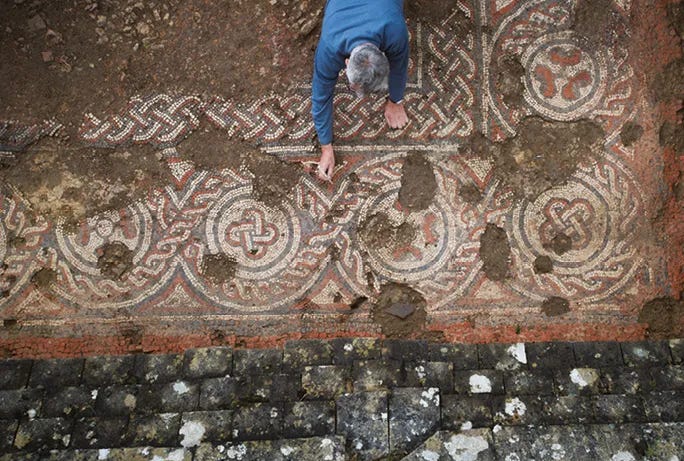
Cirencester itself has produced archaeological evidence of post-Roman occupation with the amphitheatre repurposed as a fortification including the erection of new buildings. Breeze makes the case that Gildas completed his education in Cirencester based on a reference to a (C)iren in the Vita Gildae. Given the demonstrated familiarity with the Severn region in his writing this is very credible. According to Breeze Gildas was writing in 536 making him a contemporary of Cerdic (& Caradog Freichfras). In chapter 92 of DEB Gildas writes “We greatly desire that the enemies of the Church (Pagan Saxons) be our enemies also, with no kind of alliance”. This condemnation alludes that there is an ongoing treaty agreement between some group of Britons and Saxons in the time and vicinity of Gildas’ writing.
It has been frequently suggested that Cerdic Gewising arose from such an alliance. As outlined Caradog Freichfras was the first king of Glewising ruling a large area that spanned from south east Wales over the Severn to Cirencester incorporating Gloucester (which is logical given Glewis means “people of Gloucester”). Two late manuscripts also call Caradog “Earl of Hereford” and “Prince between Wye and Severn”. Critically the Buchedd Collen tells us Caradog’s father “was married to Margred, daughter of the Earl of Rhydychen (Oxford)”. As previously discussed the upper Thames valley around Dorchester and Abingdon in Oxfordshire was settled by a population that resembles a Saxon federate appendage to Britannia Prima. The importance of a recorded marriage alliance between the Saxons of Oxfordshire with British aristocracy from Cirencester-Glewising shouldn’t be understated. This union produced Caradog Freichfras who is becoming increasingly synonymous with Cer(e)dic Gewising.
The final Cerdic-Caradog convergence relates to the ASC entry for 577: “Ceawlin fought against the Britons, and they slew three kings, Conmail, and Condidan, and Farinmail, at the place which is called Deorham, and took three cities from them, Gloucester, and Cirencester, and Bath.” It has been inferred from this entry that Cynfael (Conmail) was Sub-King of Gloucester, Cynheiddon (Condidan) Sub-King of Cirencester and Ffernfael (Farinmail) Sub-King of Bath. While not a commonly used name, the ByS lists a “Cynheiddon” son of Cynyr ap Caradog Freichfras. As previously mentioned the “Lay of the Horn” states “I give it (Cirencester) to you (Caradog Freichfras) for life and to your children”. It seems very feasible that the Cynheiddon son of Cynyr ap Caradog listed in ByS inherited rule of Cirencester and is the same Cynheiddon listed as deposed in Cirencester in the ASC. Ceawlin (Caw) son of Cynric (Cynyr) son of Cerdic (Caradog) fighting a Cynheiddon son of Cynyr (Cynric) son of Caradog (Cer(e)dic) for control of Cirencester should then be viewed as an internecine conflict rather than an inter-ethnic one.
Furthermore in the PP we are told Gloyw was son of Caw son of Cwrda son of Caradog Freichfras. As previously mentioned “Gloyw” is the eponymous founder of Gloucester and not a real personal name. It is therefore interesting to see the Welsh doppelgänger of Ceawlin, the conqueror of Gloucester, attributed this eponymous son. If Caw is Ceawlin then Gloyw is probably a mistaken memory of his acquisition of Gloucester.
If the battle of Deorham was an internecine conflict between Cynheiddon and Caw then it may be that the Welsh pedigrees preserve a more accurate genealogy as it is unlikely (but not impossible) two brothers (Cynheiddon ap Cynyr vs. Caw ap Cynric) would be on opposite sides of a battle whereas two cousins is more feasible (Cynheiddon ap Cynyr vs. Caw ap Cwrda). As early genealogical pedigrees were often incorrectly conflated with regnal lists they frequently contain mistakes.
In summary the evidence equating Cerdic Gewising with Caradog Glewising is fragmentary and tenuous in places but strong enough to conclude they were, at least in part, traditions remembering the same historical individual. This composite Ceredic was a British Overking ruling primarily the people of Gloucester (Glewis) and Cirencester but also extending his rule westwards founding the kingdom of Glewising. Ceredic may have had a mother from the Oxfordshire based Saxon foederati. The descendants of Ceredic engaged in some kind of internecine conflict from which multiple factions developed. One of these factions had a strong alliance with the Oxfordshire Saxons and this group went on to become the kingdom of Wessex.
Caradog ap Alauc
Before we unravel the sequence of events comprising this internecine conflict first we will attempt to decipher the real genealogy of the composite Ceredic. Welsh tradition preserves two distinct genealogies tracing Caradog Friechfras’ ancestors back to two prominent northern figures either Coel Godebog or Cunedda Wledig. These are both very likely to be legendary fabrications. In most sources Caradog Freichfras is made son of Llyr Marini. “Llyr” is a Brythonic term meaning “the sea” and the epithet “Marini” is also a Latinisation of “the sea”. “Llyr” is not commonly used as a personal name with the only other real example being the Mabonogion euhemerised deity Llyr the father of Bran and Manawydan (where Manawydan ap Llyr is equivalent to the better known Irish Manannan mac Lir). In the Mabinogion tradition Bran ap Llyr has a son named Caradog based on the historical Caratacus ap Cunobelinus. It is likely Llyr Marini as a father of Caradog Freichfras is a confusion based on this mythology. Caradog Freichfras was mistakenly conflated with Caradog descendent of Llyr. Therefore this mythological ancestor “Llyr” can be rejected as a genuine patronym and the search for the composite Ceredic’s father refocused back to English sources.
The ASC, WSGRL and Asser all list the name of Cerdic’s father as “Elesa”. Most attempts to identify Cerdic’s father have used this patronym. The most common suggestion is that the Sub-Roman British ruler “Elafius” mentioned in the Vita Germani and Bede could have been a scribal error for “Elasius” and thus identified with “Elesa”. Breeze has demonstrated this is historically and philologically impossible. The floruit of Elafius is nearly a century too early and his name derives from the Roman “Elaphus” (Greek “Elaphos” meaning “Deer”).
A more careful look at the genealogical sources is necessary. To simplify the modern academic consensus based on the work of Sisam, all names prior to Cerdic in the pedigrees are suspected to have been borrowed from the pedigree of Bernicia which are mainly composed of mythological or eponymous figures like “Woden” or “Gewis”. It may be the case that no accurate patronym has been preserved. Sisam deduced that the ACP pedigrees contained the oldest version in which the name of Cerdic’s father is listed as “Cerdic Alucing” i.e. “Aluca” (or “Aluc”) not “Elesa”. The corresponding name in the Bernician pedigrees from which it was supposedly borrowed are “Alusa” in the ACP and “Aloc” in the ASC. It is curious why any educated genealogical compiler borrowing from the Bernician pedigree would choose to insert Cerdic in this generation which misaligns the comparative dating by three generations. It is also curious why the original and oldest Bernician “Alusa” seems to have been corrupted to the Wessex “Aluca” with a “c”, a form which was then reborrowed back as the Bernician “Aloc” by the Wessex compilers of the ASC but simultaneously corrupted to “Elesa” in the same document. It is an incoherent mess. One solution is that the original compiler of the oldest and most authoritative Wessex pedigree had a genuine patronym for Cerdic as “Aluc” and seeing the similar form “Alusa” in the Bernician pedigree borrowed the earlier names to fill in the unknown blanks. This would explain why Cerdic is inserted multiple generations too early relative to Ida of Bernicia and why the name “Alusa” wasn’t borrowed exactly but introducing a corrupt “Aluc”. Unfortunately there is too much uncertainty to even conclude which dynasty the name “Aluc” originally belonged to or even in which direction borrowing occurred as both pedigrees were compiled around the same time by the same people while Northumbria and Wessex were allied which further motivated the genealogical merger.
A philological analysis of the two variations of the name Elesa/ Alusa and Aluc/ Aloc actually indicates they may have originally belonged to the Wessex pedigree. Neither form fits well with a Germanic root but both fit well with known Brythonic names. The Brythonic name “Elise” is a credible root for “Elesa” and is commonly used amongst Welsh dynasties, most prominently the Vortigern descended Cadelling rulers of Powys. Unfortunately there is no suitable candidate for a father of Cerdic found with this name. “Aluc” as we shall see also fits with a known Brythonic name. As shown above Brythonic names are common in the Wessex pedigrees but not in the pedigrees of Bernicia. This makes Elesa/ Aluc more likely to have originally belonged to Wessex than Bernicia.
Without overthinking things we will simply use the oldest and most authoritative variation of the name “Aluc” to search for a possible identity for Cerdic’s father, as an exercise if nothing else. To recap the requirements for a suitable candidate: must be named something compatible with “Aluc”; must credibly be father of the composite Ceredic; must be compatible with a 530s floruit for Ceredic; must be connected in some way to “Glewis” i.e. people of Gloucester and possibly connected to Vortigern (recall Vortigern’s “interpreter” named Ceredic). An individual that ticks all these boxes would be a strong candidate and as it happens there is a perfect match.
In the “Vita Sancte Wenefrede” we are told “Caradog son of Alauc, born of royal ancestry” attempted to seduce Saint Winifred. This “Alauc” is the only independently recorded person in English or Welsh tradition with this name. The equivalence of “Caradog son of Alauc” to Cerdic son of Aluc is almost too good to be true. “Caradog son of Alauc” having his advances spurned “caught up to her with a sword, cutting off her head”. Saint Beuno performed a miracle by resurrecting Winifred “the body regained life with all its faculties, with nothing but a slender scar being evident on her neck. But the ground stained with her blood burst open, and a rushing spring gushed forth watering the ground in that place.” This is the founding myth for St Winifred’s Well in Holywell, Flintshire. Winifred is from the Brythonic Gwenfrewi meaning “blessed stream” a common hydronym in Wales. Miraculous tales in hagiographies are highly questionable but the historical figures mentioned within are usually real persons.
The name “Alauc” is widely attested throughout Roman period Britain and Gaul with inscriptions to “Alaucus” found at Wroxeter, Silchester, Ilkley and elsewhere. Watkins writing on the sound change “Alaucus beside Alacca” says “that in the Gaulish and British forms above a pattern -vC- has been substituted for the regularly developed -vCC-”. It is probably a similar sound shift between the original Brythonic “Alauc” and the “Aluca” or “Aluc” of the ACP. “Alauc” is clearly compatible with “Aluc” and he clearly fathered a “Caradog”. This satisfies our first two requirements.
This story featuring Caradog and Gwenfrewi is repeated in various sources but only Peniarth MS.131 repeats the patronym “Alauc”, here recte “Owain Pennyferw, who killed Caradog son of Alaog, king of Pen Alaog.” “Pen Alaog” is the modern place name Hawarden with corrupt recorded historical forms “Pennard Halawg” and “Pennard (A)laoc” in ByT. Both Holywell and Pen Alaog are in the furthest north east corner of modern Wales which was the historical cantref of Tegeingl bounded by the Clywd to the west. The 21st entry in an obscure Welsh manuscript called “Achau Brenhinoedd a Thywysogion Cymru” (ABT) (”Pedigrees of the Kings and Princes of Wales”) under the heading “Gwehelyth Dyffryn Clywd” (“The lineage of the Vale of Clwyd”) lists the following pedigree: “Alaoc (F)wr ap Iddig ap Cadell Deyrnllug”. The name “Alaoc” is also spelled “Alac”/ “Alawc”/ “Alawg” in other versions. The epithet “Fwr” means “the Stout”. This “Alaoc” from the Vale of Clwyd is the same “Alauc” king of “Pen Alaog” father of “Caradog”.
Caradog ap Alauc being situated in the Vale of Clywd doesn’t align well with a ruler centred in Gloucester-Cirencester. The rulers traditionally associated with the Vale of Clywd were the Dogfeiling dynasty. We learn from “Peniarth MS.131” that Owain Pennyferw’s father was named “Tyfid”, furthermore from “Buchedd Beuno” that “Gwenfrewi” was also daughter of “Tyfid” who was son of an unidentified “Eliud”. According to “Achau’r Saint” Gwenfrewi was daughter of Gwenlo who was daughter of Bugi who was the father of Beuno. The full pedigree of Beuno and Gwenlo going back to Cadell is given in the “Buchedd Beuno”. Attempts to identify Gwenfrewi’s paternal grandfather “Eliud” with the son of Cynan Garwyn are flawed as there is six generations from Eliud ap Cynan to Cadell and only five from Gwenfrewi to Cadell. It is unlikely Gwenfrewi was in the generation above her own grandfather. This “Eliud” hasn’t been definitively identified but the “Elud” listed as a descendent of Dogfael ap Cunedda and ruler of the Vale of Clywd in JC 50 and ABT 27 fits perfectly both generationally and geographically (Clywd). See the figure below to visualise the pedigrees discussed above.
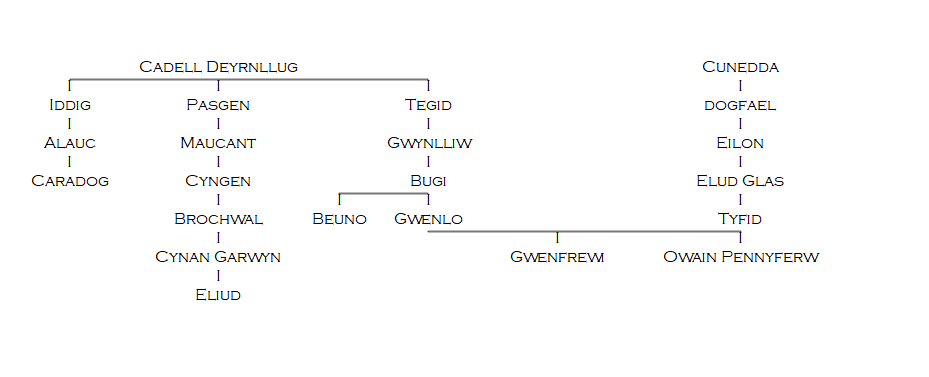
According to “Marwnad Cynddylan” the Dogfeiling were fierce rivals of the Cadelling “the hereditary ruler of Dogfeiling, a terror to Cadell’s descendants”. Caradog ap Alauc was a member of the Cadelling dynasty as mentioned above. This makes it likely that the loose memory of Caradog the Cadelling clashing with Owain Pennyferw the Dogfeiling was a battle or raid of some kind. It is therefore likely Caradog was an external invader raiding Dogfeiling lands and not a local ruler himself. These events were remembered only in local Flintshire tradition and Caradog was incorrectly relocated locally. These erroneous relocations are a common phenomena in Welsh tradition.
The Cadelling dynasty is mostly known for ruling the kingdom of Powys but, as we will discuss later, Koch has demonstrated this was only from the time of Cynan Garwyn onwards. In the late 6th century Taliesin poem “Trawsgan Cynan Garwyn” (TCG), following Koch’s interpretation, we are told Cynan was in the process of adding “Cornouii” to his rule. “Cornouii” was the Sub-Roman successor to the large Roman period civitate of the same name encompassing mostly modern Shropshire, Cheshire, Staffordshire, Powys and included the Roman cities of Chester and Wroxeter. Cynan is in fact referred to as “the leader of Heechan” which is modern day Herefordshire and represents the core territory of the Cadelling dynasty at this time. The “Heechan” (Also called “Western Hecani”, “Westerna” or “Magonsaete” in other sources) were within the Roman period civitatas of the Dobunni. The civitate of the Dobunni was comprised roughly of Gloucestershire (later Hwicce) and Herefordshire (Heechan). The Sub-Roman Heechan were most likely ruled by Sub-Kings subordinate to the rulers in Gloucester-Cirencester (Hwicce).
As our Caradog son of Alauc is listed as a different branch of the pre-Cynan Cadelling dynasty it is most likely he was also based somewhere within the twin kingdoms of the Dobunni i.e. Heechan (Herefordshire) and Hwicce (Gloucestershire). A raid conducted by Caradog ap Alauc on the rival Dogfeiling of north east Wales would be entirely in line with expected behaviours for a Cadelling. As previously stated Caradog Freichfras is also called “Earl of Hereford” and “Prince between Wye and Severn”. Furthermore in the PP we are told “Caradog Freichfras… ...king of the North and Earl of Hereford; and from his name was bestowed upon it Caer Caradog, and today it is called Hereford.” This reference seems to explicitly outline Caradog Freichfras’ sphere of influence extended into north Wales. This dovetails perfectly with the likely Herefordshire-Gloucestershire based Cadelling Caradog ap Alauc raider of north Wales. The Book of Llandaff (BoL) also records a land grant to Saint Teilo by King Iddon son of (C)ynyr ap Caradog. In the original manuscript the place name given is “porthalauc” which seems to be comprised of two elements Porth + Alauc meaning “Gateway of Alauc”. This is modern “Llantilio Pertholey” not far from “Ewis” and Herefordshire. As “Alauc” is such a rare name only attributed to a single historical figure this may indicate his past presence within the domain of (C)ynyr ap Caradog. Therefore there is no geographical objection to identifying Caradog ap Alauc with Caradog Freichfras and our composite Ceredic.
To accurately calculate the floruit of Caradog ap Alauc we must compare it to the better known branch of the Cadelling dynasty, namely the kings of Powys. Multiple contradictory pedigrees exist for the Cadelling of Powys but a good starting point is the Pillar of Elise which was erected in the early 9th century by the Cadelling themselves so it represents an authoritative contemporary genealogical document. While it doesn’t preserve a full pedigree it does confirm the Cadelling considered themselves descendants of Vortigern. The two Cadelling pedigrees preserved in the Harleian MS omit Vortigern. This is because these pedigrees were composed for the kings of Gwynedd after they annexed Powys. Vortigern was portrayed as a foolish villain in the HB, which was a work of Gwynedd court propaganda, thus they didn’t wish to connect their own lineage with him. For this reason we can dismiss the Harleian pedigrees as inaccurate. This leaves us with the JS MS. 20 pedigree which appears to be accurate with the exception of omitting Cyngen the grandfather of Cynan Garwyn. We know from the aforementioned 6th century poem TCG that Cynan was son of Brochwal and grandson of Cyngen. Therefore we will use the rectified JS MS. 20 pedigree (inserting Cyngen) to calculate the floruit of Caradog ap Alauc. Selyf ap Cynan who fought and died at the Battle of Chester in the early 7th century provides an approximate datum of 600 as the beginning of his floruit. Using a generational increment of 25 years for the sake of ease we can calculate a date of approximately 525 (600 - (25*3)) for the floruit of Caradog ap Alauc. This date of 525 for Caradog ap Alauc is perfectly compatible with Dumville’s proposed 530s for Cerdic son of Aluc.
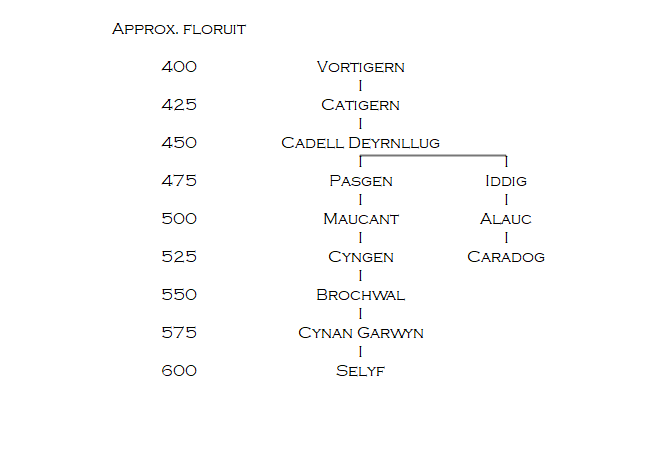
While the “Cadelling” took their dynastic name from “Cadell Deyrnllug”, his grandfather at the beginning of the pedigree is “Vortigern”. This satisfies our final requirements of a suspected link between the composite Ceredic and Vortigern (the role as Vortigern’s Saxon intermediary given to a “Ceredic” in the HB). As we have already established earlier Vortigern was from the “people of Gloucester” (Glewis). In turn Caradog ap Alauc ultimately also belongs to the “Glewis” along with the rest of his pre-Cynan Cadelling kin of Heechan (Herefordshire).
There is a limited cast of recurring characters present in the hagiographies of the Welsh saints. For example the (C)ynyr without patronym in Buchedd Beuno is generally assumed to be the same (C)ynyr ap Caradog from Life of Tathan (LoT). It isn’t an unreasonable assumption that the Caradog without patronym mentioned in the LoT is the same person as Caradog ap Alauc in Life of Winifred and Buchedd Beuno. The hagiographers were drawing on the same pool of legendary figures but often portrayed in different guises. The Life of Cadog (LoC) identifies King Gwynllyw as father of Cadog and ruler of a Sub-Kingdom of Glewising called Gwynllwg. The LoT mentions King Gwynllyw as a semi-hostile contemporary of (C)ynyr and his father Caradog, portrayed here as rulers in neighbouring Gwent. This Caradog is securely identified with Caradog Freichfras named as the first overking of Glewising in JS MS. 20. Further confirmation comes in the LoC itself which states rule of Gwynllwg passed from Gwynllyw to Meurig ap Caradog Freichfras (and all Glewising according to JS MS. 20). Gwent was most likely a subkingdom of Glewising at this time with Caradog as overking. The LoC names Gwynllyw’s father as “Glewis” and grandfather as “Solor”. As Bartrum tells us “Glewis” means “people of Gloucester” and “Solor” derives from the tribal ethnonym “Silure”, both are fictional eponymous figures which points to this being a fabricated pedigree. The ByS gives us an alternative pedigree “Gwynllyw ap Glewis ap Tegid ap Cadell Deyrnllug”. The “Buchedd Beuno” gives the same pedigree but correctly omits “Glewis”. If “Glewis” was originally a territorial epithet belonging to Gwynllyw later mistaken for a patronym this would explain the confusion. If Gwynllyw Glewis (ap Tegid ap Cadell Deyrnllug) were a grandson of Cadell Deyrnllug it would make him a first cousin once removed and contemporary of Caradog (ap Alauc ap Iddig ap Cadell Deyrnllug). Accepting these proposed pedigrees would explain the strange geographical and hereditary entanglement between the family of Gwynllyw and Caradog that is present in the hagiographies. It would also strongly imply that Caradog ap Alauc was a southern ruler around Glewis and the same person as Caradog Freichfras, in other words the composite Ceredic.
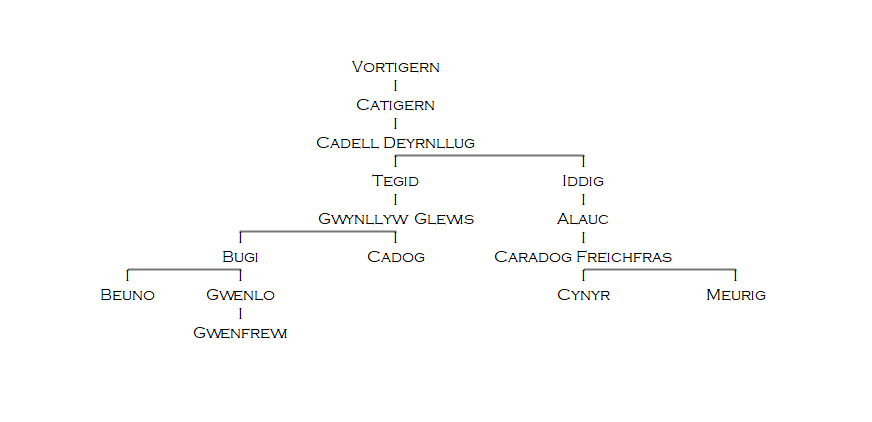
Caradog ap Alauc fits all the necessary criteria for a genuine preservation of a genealogy for the composite Ceredic. If therefore Cerdic Gewising was a direct patrilineal descendant of the legendary Vortigern it would explain a lot of the mysteries previously outlined and would speak to the incredible resilience of powerful aristocratic dynasties. The deepest roots of the Kings of Wessex and Kings of England seem to lie within this ancient British dynasty.
Excellent work!