

Some of these are getting full articles soon, but I have unfortunately been fairly sick and couldn’t be bothered to write anything. A handful of articles are sitting half finished, one on Ida of Bernicia, another revisiting the Brigantian High-Kingship theory and the evidence for Anglian foederati presence in the early Kingdom of Ebrauc, and another on Urien and Guallauc. Writing has slowed on part two of ‘Tales of the Coeling’, but three longer stories are finished, with about seven more to go. I am aiming for longer stories this time, but I see no reason to garden a story to be longer when it can be told with brevity and punch. I’m hoping to finish this by the summer at the latest.
On to the reconstructions.
As I am including eight reconstructions in a single article, I will only include a brief description of each figure shown, who they were and when they ruled.
Ceneu ap Coel
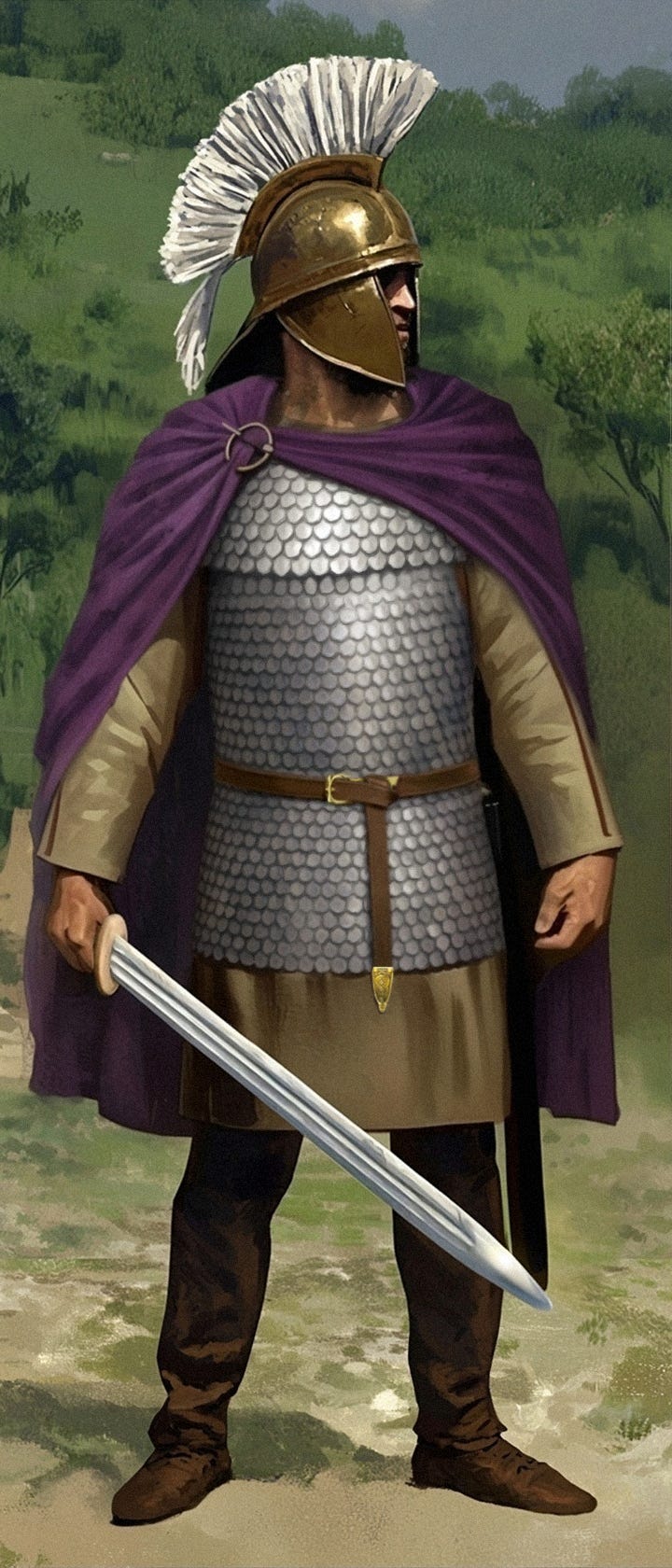
Son of Coel Hen. Ceneu seems to have continued his father’s work of unifying and refortifying the lands around Hadrian’s wall (you can read about that here), bringing what would become Rheged under Coeling influence as it seems his son Gwrwst, great-grandfather of Urien was established as the first Coeling king of Rheged. Upon his father’s death some time around 440, Ceneu became king. Unlike the figures of his grand-children and great-grandchildren’s generation he does not feature in much poetry, except for one disputed reference in one of the Urien poems. This disputed reference has been used to claim that Ceneu is a back-dated genealogical link stemming from confusing a word for a name. This however is disputed, as Ceneu does become a common name amongst the later Coeling princes, possibly named for this son of Coel. Church tradition has Ceneu abdicating as king and retiring to Wales as a monk, founding the a church known as Llangeneu in modern Clydau. This is a common motif attributed to many figures, and while it is possible, it is not a certainty that this attribution is true.
Ceneu is depicted here with a helmet of the Iatrus type, with a detachable crest, which seems to have been held internally with tabs slotted into small slots in the top of the helmet, then folded over. He wears high-status scale armor, and a sword similar to the Feltwell Spatha.
Mar ap Ceneu
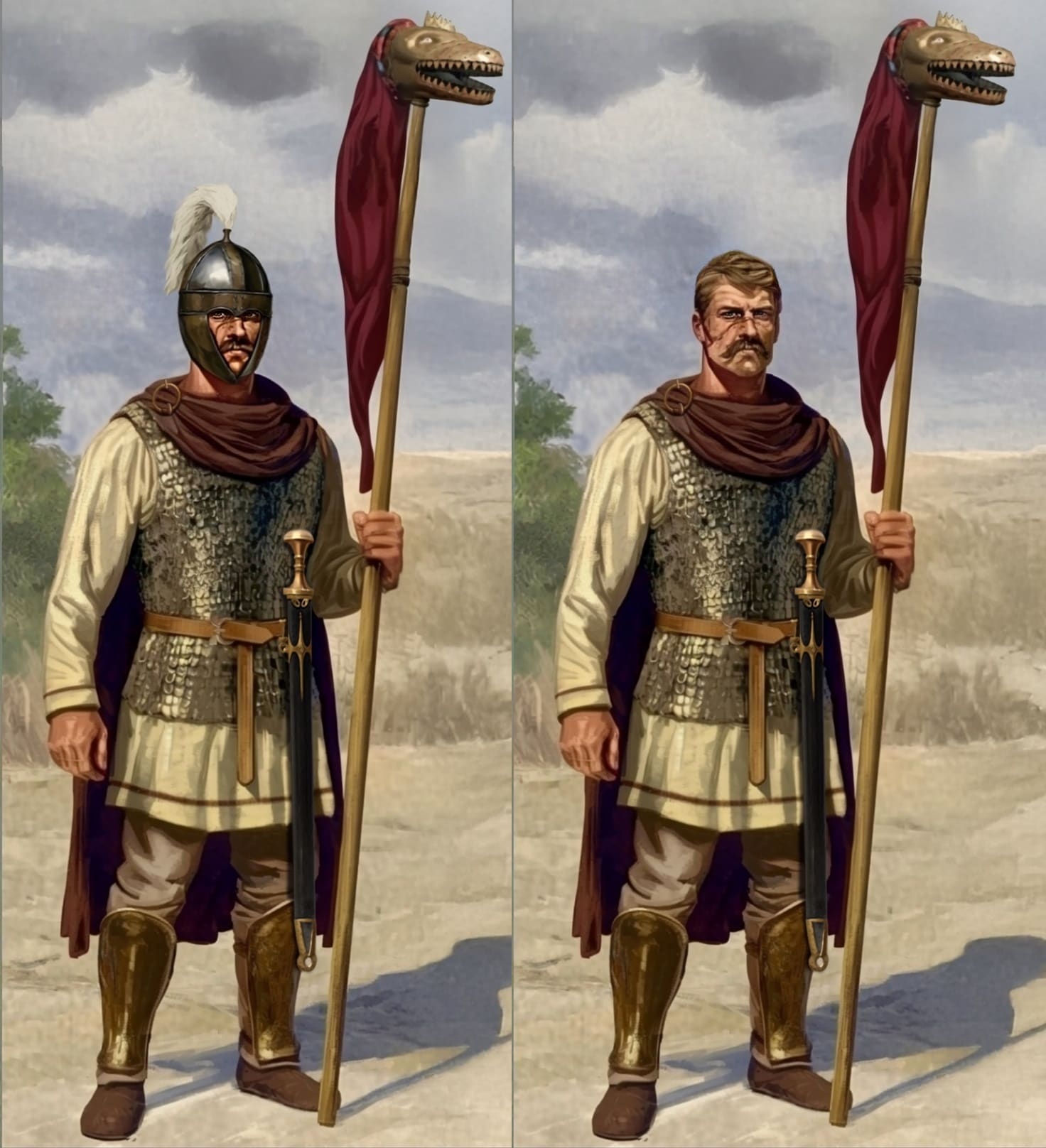
The Son of Ceneu ap Coel, very few references to him exist, and he is seen in the pedigrees under the name Mar and also Maeswig/Masguid Gloff (the lame). From Mar’s descendants we can conclude that he ruled the eastern lands of the Coeling, in what would eventually become Ebrauc, and Elmet, and possibly the Pennines, while his brother Gwrwst ruled the western portion in Rheged. Mar may feature in the Stanzas of the Graves, though the parentage is garbled. We do get a bit more info from an odd and generally untrustworthy place, Geoffrey of Monmouth’s Historia Regum Brittaniae, where Geoffrey gives an account of a wicked king Morvidus, who makes battle upon a monster from the Irish sea. This may be wholly invented by Geoffrey, but it may also contain a kernel of folkloric memory of the onset of the Irish invasions that eventually led to the founding to Scottish Dal Riata. With his rule beginning sometime between 460 and 470, he would have been contemporary with Fergus Mor of Dal Riata, and Fergus may be the ‘great beast’ that Morvidus falls in battle to.
Mar is depicted in the reconstruction with an early continental style spangenhelm, simplified scale armor without the upper collar reinforcements, while still bearing uncommon and high-status greaves. He wears a sword of the Kragehul bog type, and carries a Draco, inherited from the Romans.
Llenneac ap Mar
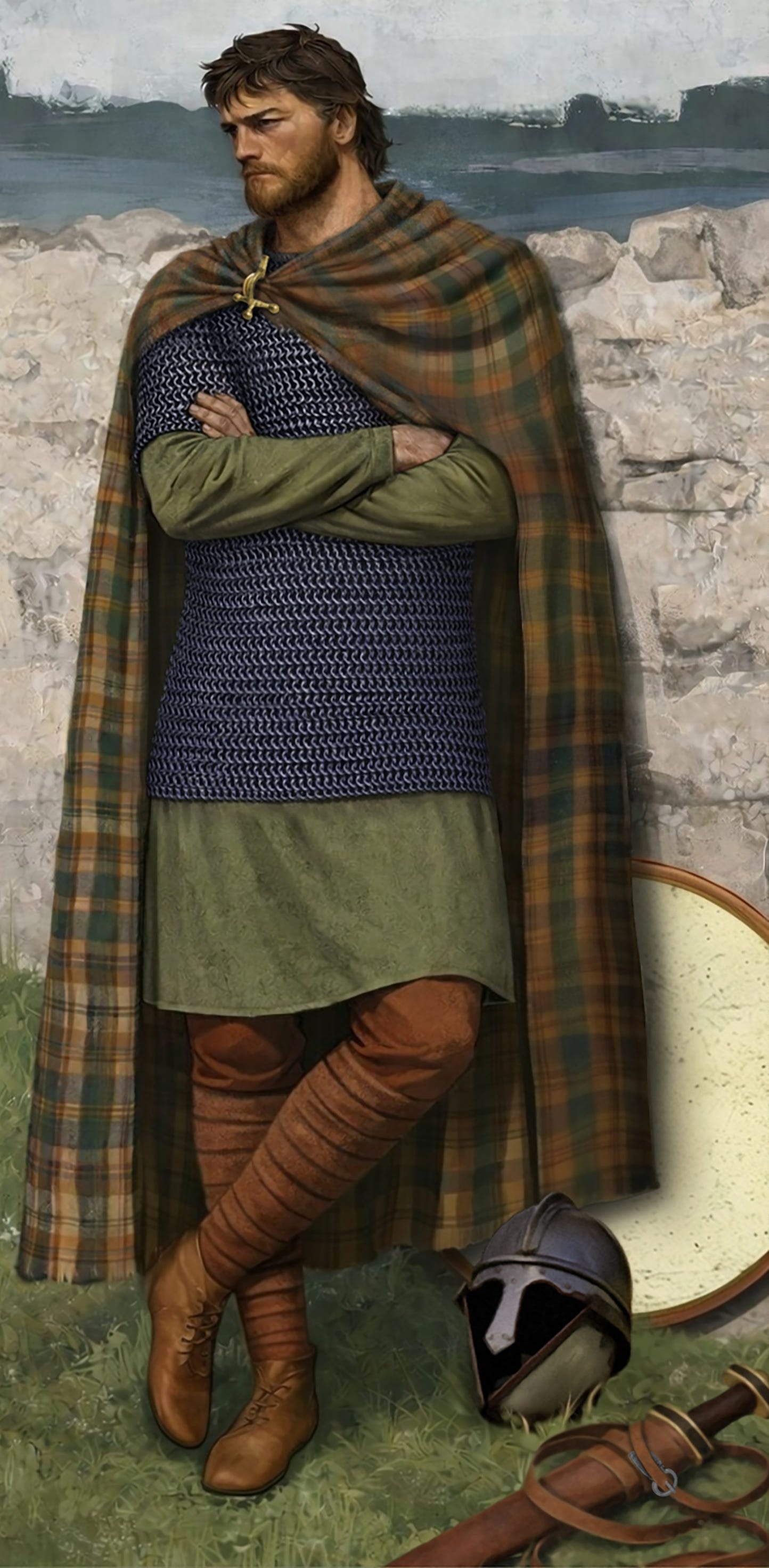
The son of Mar ap Ceneu, Llenneac seems to have been the first king of Elmet. Like his father, there are few references outside of the pedigrees, however Llenneac does get referenced in a song dedicated to his son Guallauc in the book of Taliesin. Outside of this we can speculate however. There is an early figure in Arthuriana seen in Culhwch and Olwen named Llenlleog. Llenlleog is notable for being one of the only figures seen wielding Caledfwlch (Excalibur), killing the giant Diwrnach and his retinue. This incident in Culhwch and Olwen seems to be a reworking of the raid in Preiddeu Annwfn, with Llenlleog a later form of the shadowy Lleminnauc. Lleminawc in turn is probably a combination of the historical Llenneac of Elmet, contemporary with the historical Arthur, and the god Lugh, either borrowed from the Irish directly, or from their shared Proto-Celtic heritage in the form of Lugus, or even directly from the Welsh equivalent Lleu. This combination filtered through the centuries eventually finds it’s way to Breton bards, and then to later Romance writers like Chrétien, leading to Lancelot. You can read more about this here.
Llenneac is seen here with a mix of Roman and local British kit, and the ‘lime-washed’ shield referenced in Y Gododdin.
Guallauc ap Llenneac
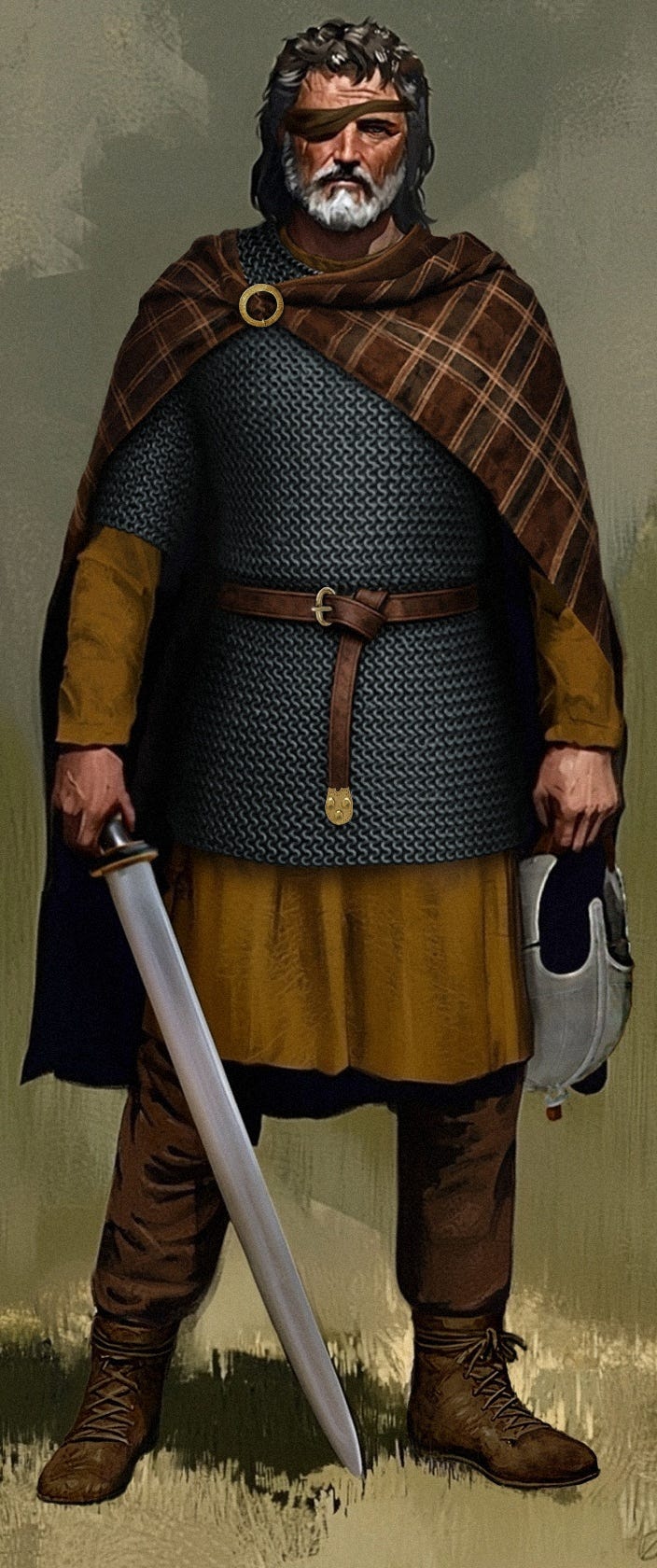
The son of Llenneac of Elmet, Guallauc features in both the pedigrees and multiple praise poems from the Brythonic Heroic Age. Gualluac seems to have been quite the rough customer, bringing war to any and everyone in the Hen Ogledd. Fighting in Aeron, in Ebrauc, eventually against his own cousins in Rheged.
Enemies were wiped out by Gwallawg.
You’re a better stockade than a pack of bears.
War by the sea from the pulse of song,
His fight was more than York’s men could endure.
You can find more about Guallauc here.
I have chosen to depict Guallauc as a practical man with simple arms and armor, but still with the marks of status, with imported belt fittings and a boar-crested helmet.
Ida of Bernicia
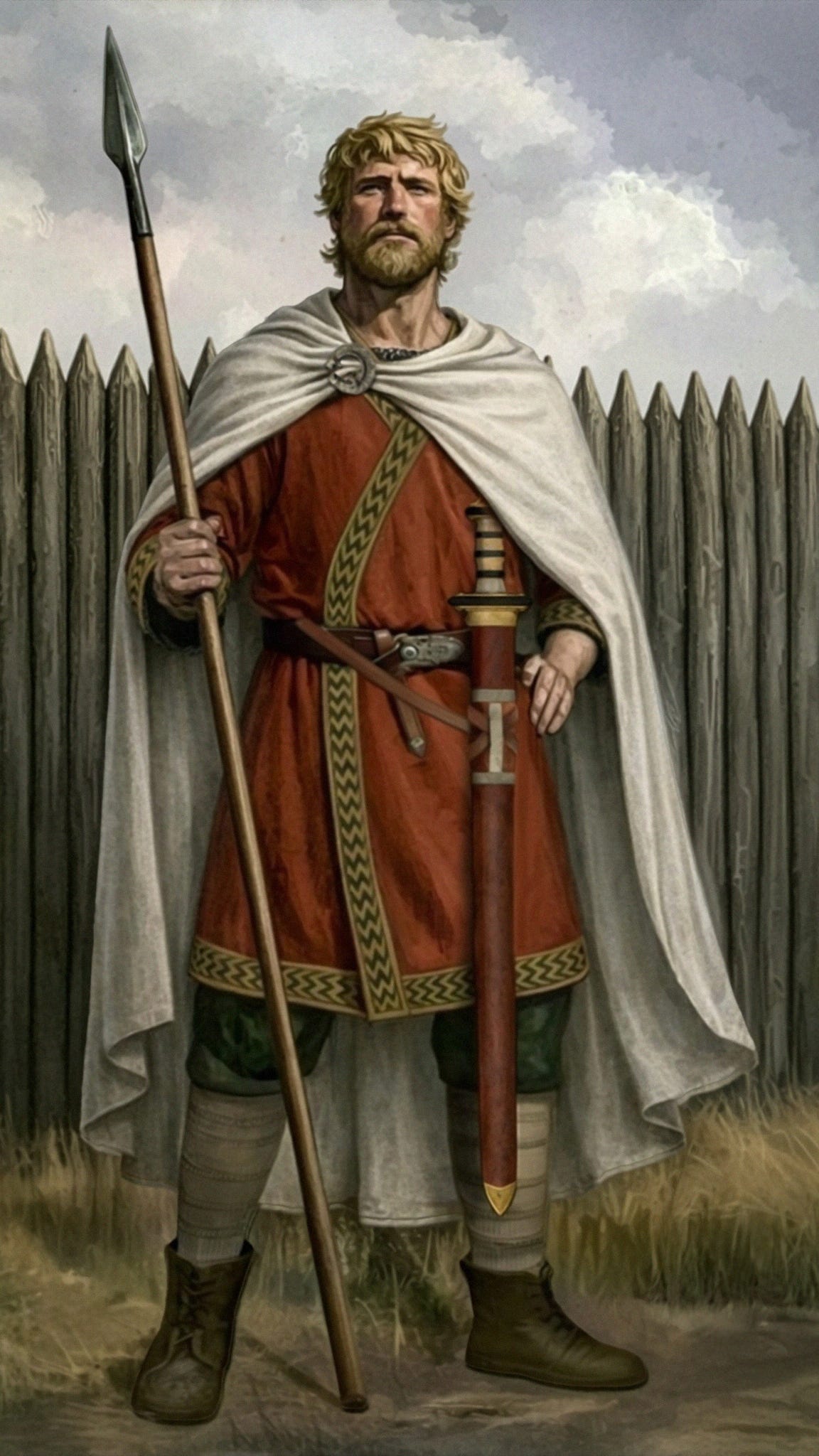
The first king of Anglian Bernicia. With the fading power of the Coeling (Brigantian) High-Kingship, Ida established himself king in 547, ruling for 12 years according to the Anglo-Saxon Chronicle. The ASC also remembers him establishing the fortress of Bamburgh, though this was likely the seat of the earlier Brythonic kings of Bryneich, then known as Din Guarie. Nennius tells us that after the period of Arthur’s reign the Angles “brought over kings from Germany that they might reign over them in Britain, right down to the time in which Ida reigned, who was son of Eobba. He was the first king in Bernicia, that is, in Berneich.” This would seem to imply that Ida’s date is some time after Arthur’s famous victory at Badon. This sits well with the idea of the post-Badon peace, and is in fact reflected in Anglo-Saxon records, as they record no significant credible battles between Aella and Cerdic, with Cerdic’s earliest dates subject to a ‘founding myth’ pattern, with him likely not taking power until the 530s some 30 years after Badon. Ida’s establishment in 547 also makes sense in this context. With Arthur dead at Camlann in 537, and Coeling power weakening, the prior Foederati arrangements held between the Coeling and Cynwydion (Kings of Alt Clut) kings of the north waning, Anglian ascent in the north seemed inevitable.
Ida is depicted here as a warlord of his time. His rich woolen robe with tablet woven hem covers his maille, with an undyed woolen cloak, fastened with a high-status silver brooch, with a sword of continental style with a garnet inlaid pommel.
Fflamddwyn
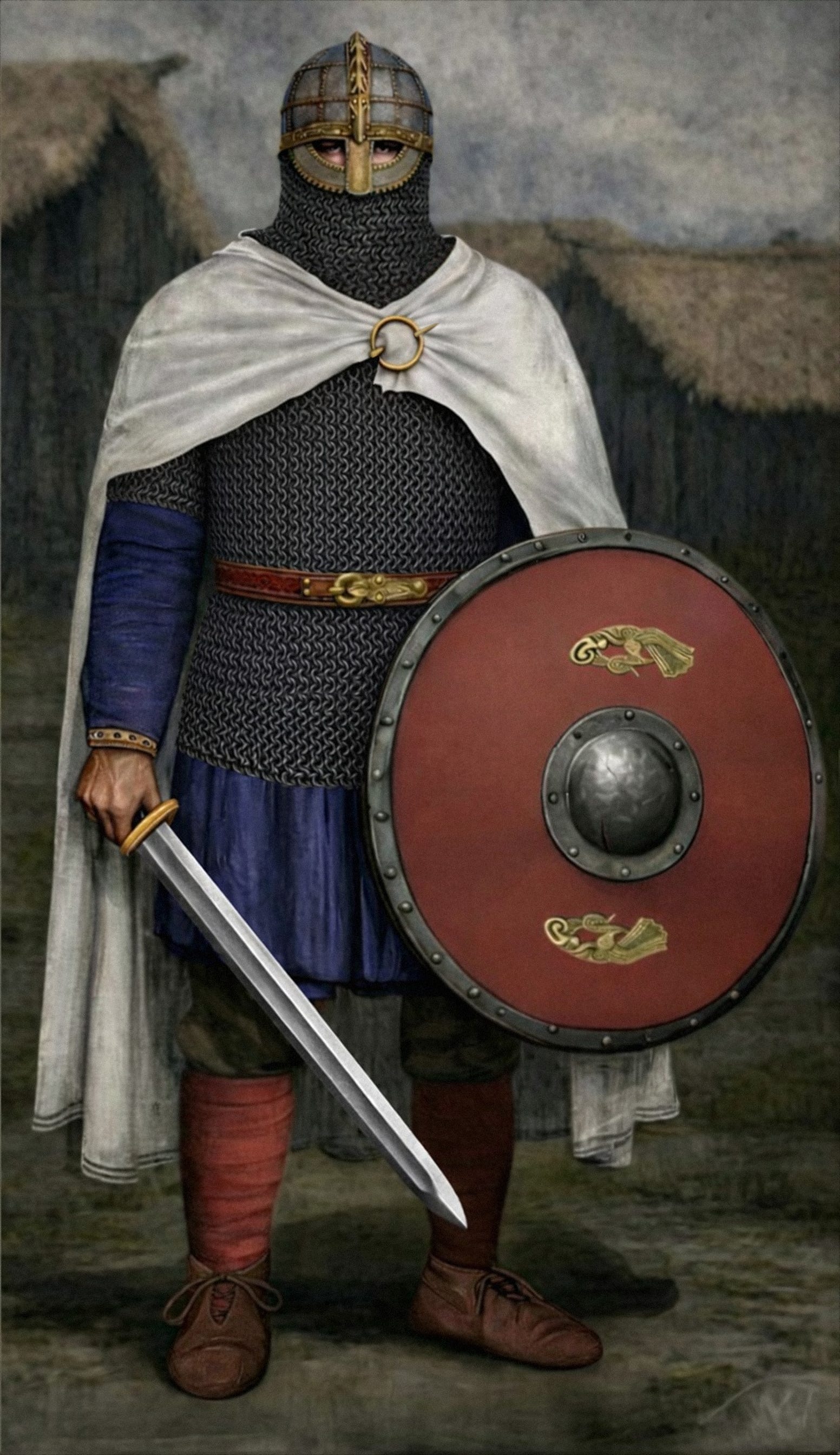
A mysterious Anglian warlord referenced in the Welsh poem The Battle of Argoed Llwyfain, a song of praise for Urien. Fflamddwyn (‘Flame-Bearer’) demands hostages of the Coeling forces, but is denied by Owain, Owain seemingly then leads the Coeling forces against Fflamddwyn, winning victory. There has been much speculation about who Fflamddwyn was, and it would seem he was an Anglian in Ida’s line, some have even speculated that he was Ida himself, though it is much more likely it was one of Ida’s sons, possibly Theodoric.
Fflamddwyn is depicted here as an Anglian warlord in full war-gear, with a helm and aventail inspired by near-contemporary Vendel helmets, and ornamented shield as seen in the Sutton-Hoo burial.
High-Status Romano-British Woman
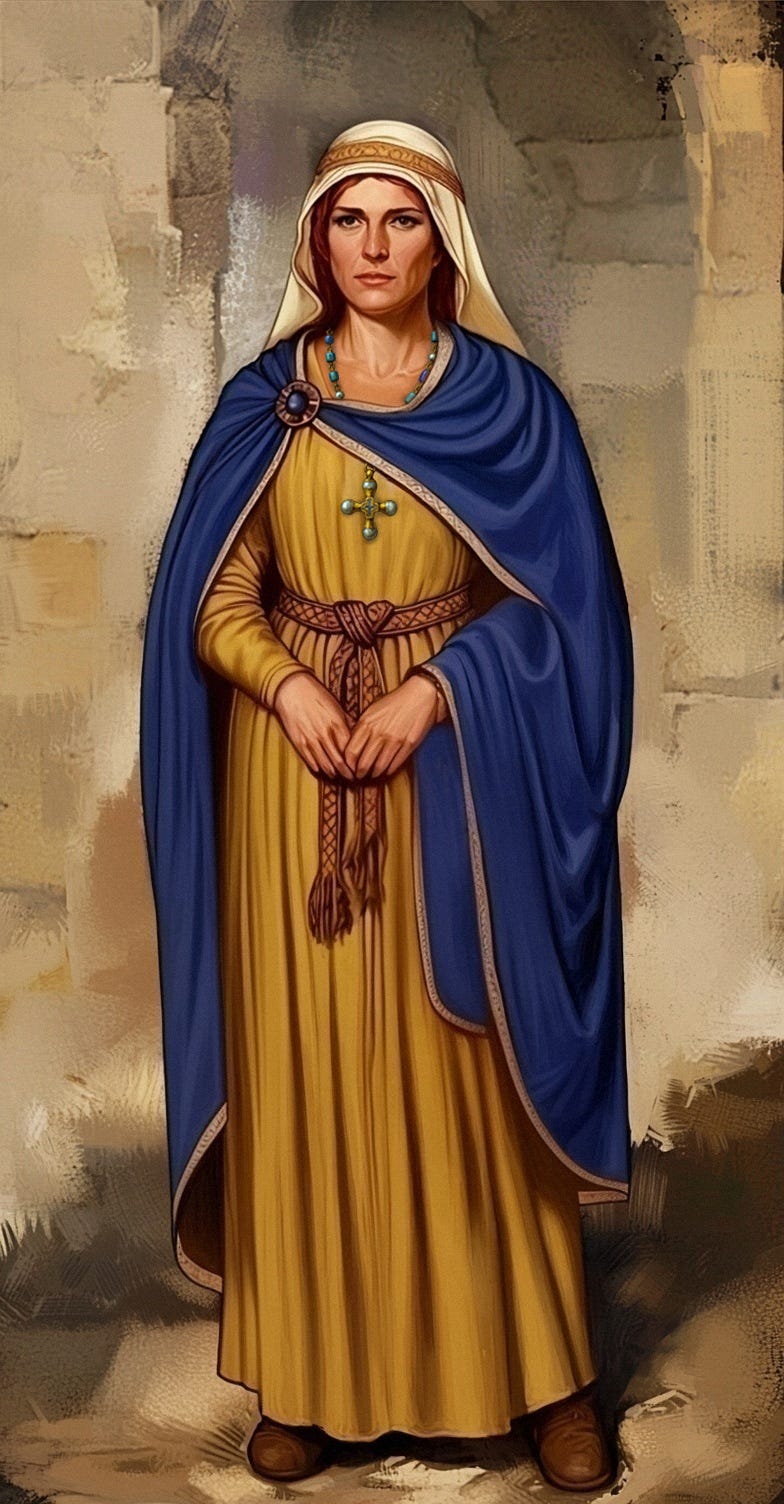
Something a little different, a High-Status Noblewoman, wearing a wealthily dyed, but simply cut dress, tablet woven belt and headband, with a lingering Roman palla pinned with an ornate brooch. She wears a imported pectoral cross from the Eastern Roman Empire.
Urien ap Cynfarch
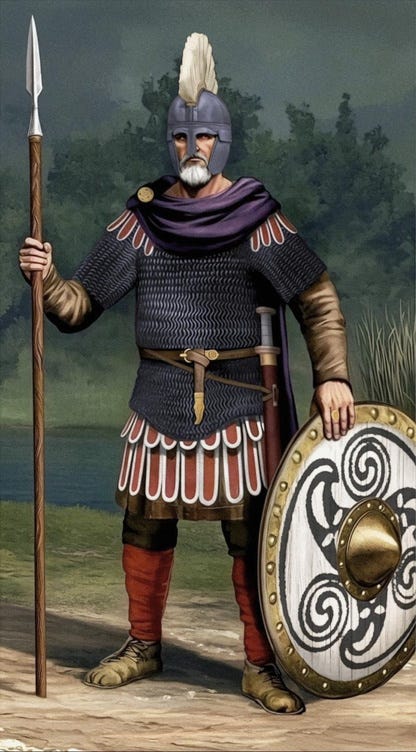
Urien of Rheged, a veritable second-coming of Arthur ruled Rheged for much of the 6th century. Long lived and long ruling, Urien features in numerous poems from Taliesin, as well as the poetry of Llywarch Hen, his cousin. Urien was probably born some time around 520ad, beginning his rule shortly after the battle of Camlann in 537. The young king would continue to ascend in fame and wealth, eventually becoming the preeminent Coeling of his era. Urien seemed to operate as overlord for much of the north, and was feared and respected by all, even Guallauc of Elmet. Urien was most likely the leader opposed to the Gododdin in the raid on Catraeth seen in Y Gododdin, likely the culmination of years of unrest with multiple Coeling princes conspiring against Urien, setting out on the ill-fated raid. Urien is most famous for nearly driving the Angles from Northern Britain, besieging them on Ynys Metcaut (Lindisfarne). The siege however ended when Urien was betrayed by a British king, likely Morcant of Alt Clut (not his cousin Morcant as often supposed).
Urien is depicted here as a the penultimate warlord of his time. Urien and his son Owain are often associated with ravens, so his shield is adorned with a Raven-Triskelion pattern inspired by the Royston Escutcheon that appears as well on his brooch. To emphasize the Romanitas of the Western Coeling I have given Urien Pteruges under the skirt of his maille, as well as the more speculative ‘shoulder-harness’ attached Pteruges over his maille (Pteruges under the maille sleeves just seems silly).
Hurry up with them chuffing articles bud.
Anymore p5ych0p0mp guest articles appearing soon?
Excellent content as usual Aurochs.
Currently on my 3rd reread of the Chronicles, easily one of the best books published in 2025.
Awesome, as always, dearest fren